Back to the Cocoa Powder Guide
To tell if cocoa powder is pure, read the ingredients list first: pure cocoa powder lists one ingredient, cocoa. Then check four more things — the color (very dark usually means alkalized, not stronger), whether the origin and producer are named, how the powder behaves in liquid, and how it tastes with nothing added.
Those five checks tell you whether a powder is blended. They cannot tell you what came out of the soil. For cadmium and lead, only a dated third-party lab report with real numbers and detection limits answers the question.
Key facts: the numbers behind these checks
| What | Value | Unit | Source and date |
|---|---|---|---|
| Ingredients on a pure, unsweetened cocoa powder | 1 (cocoa) | ingredient | 21 CFR Part 163, checked September 15, 2026 |
| EU maximum cadmium, cocoa powder sold to the final consumer | 0.60 | mg/kg | Commission Regulation (EU) 2023/915, April 25, 2023 |
| U.S. federal maximum for cadmium or lead in cocoa powder | none set | — | FDA, Cadmium in Food and Foodwares, checked September 15, 2026 |
| Flavanols, natural cocoa vs heavily alkalized cocoa (averages) | 34.6 vs 3.9 | mg/g | Miller et al., J Agric Food Chem, 2008 |
| Caffeine in 1 tbsp (5.4 g) unsweetened cocoa powder | ≈12 | mg | USDA FoodData Central FDC 169593, checked September 15, 2026 |
| Cadmium measured in the cocoa Grevista distributes | 0.081 | mg/kg | TSL Science report TSL1220400349-1, April 2022 (producer’s sample) |
What does “pure cocoa powder” actually mean?
In the U.S., cocoa is a defined food. The federal standards for cacao products (21 CFR Part 163) describe cocoa powders by their cocoa-fat content and allow alkali treatment, as long as it is declared. “Pure” is not a defined term, so on a label it usually means one of three different things:
| What the bag says | What it can mean | How to confirm |
|---|---|---|
| “100% cocoa” or “pure cocoa” | One ingredient, no sugar or fillers | The ingredients list shows only cocoa |
| “Natural” or “non-alkalized” | Not treated with an alkali | No “processed with alkali” in the ingredients |
| “Tested” or “clean” | Anything from a full lab report to nothing at all | A report with lab name, reference number, date and numbers |
Check 1: What should the ingredients list say?
One line: cocoa, or cocoa powder. It takes three seconds and removes most of the confusion on the shelf.
| What you see | What it means |
|---|---|
| Cocoa, and nothing else | Pure, unsweetened cocoa powder |
| Sugar, milk solids, maltodextrin, starch | A drink mix or blend, not plain cocoa powder |
| Soy lecithin or another emulsifier | Added so it mixes into liquid faster |
| “Processed with alkali”, “alkalized”, “Dutch-processed” | Still cocoa, but alkalized: milder, darker and lower in flavanols |
| Anti-caking agent | Added to keep the powder from clumping |
Alkalized cocoa is not impure. It is a different processing choice, and the trade-offs are covered in natural vs Dutch-process cocoa powder.
Check 2: What is the color telling you?
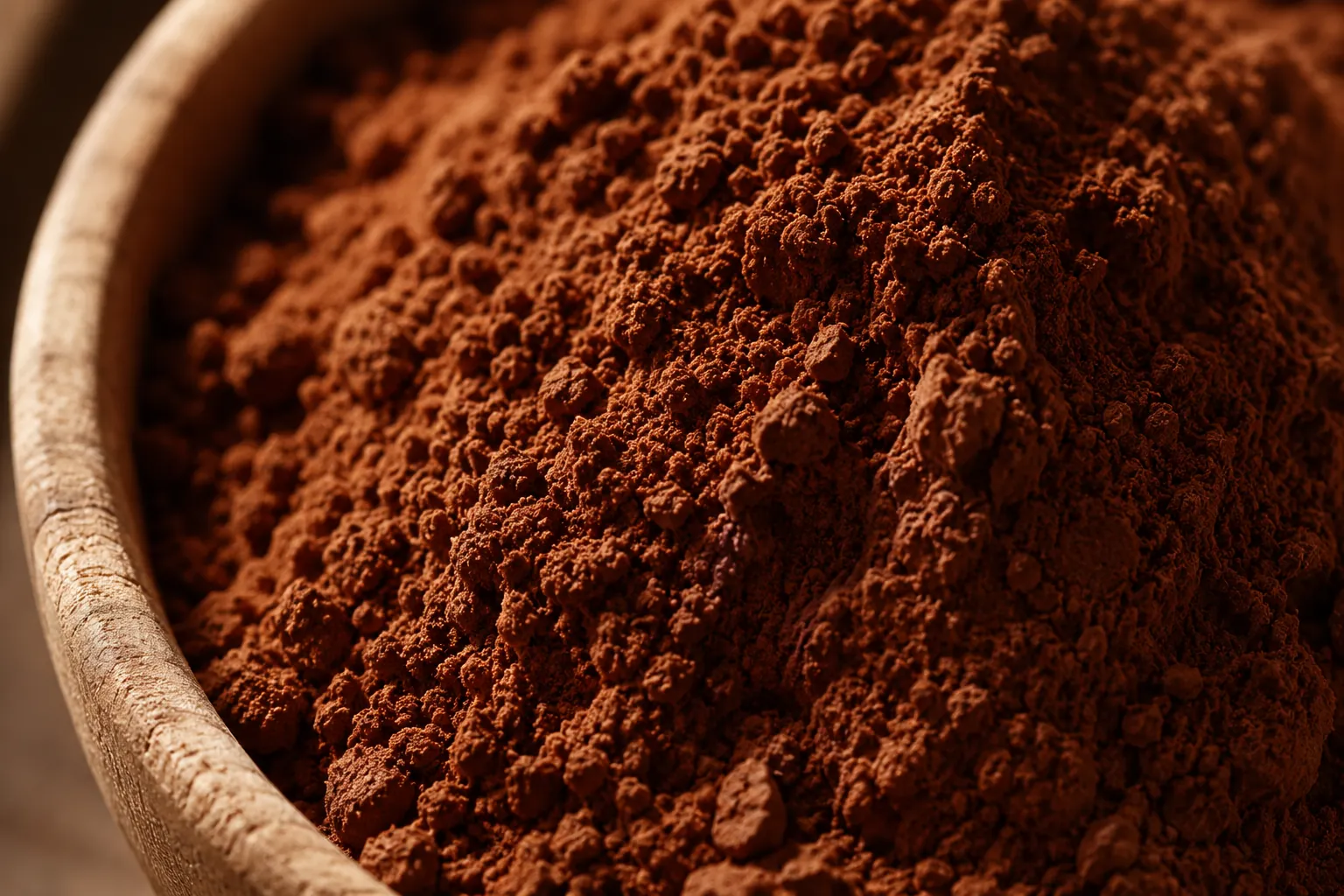
Most shoppers assume darker means stronger or better. Usually it means more alkali. A 2008 analysis of commercial cocoa powders found that flavanol content fell as alkalizing pushed the pH up.
| Color | What it usually is | Flavanols (2008 analysis, average) |
|---|---|---|
| Light to medium reddish-brown | Natural, non-alkalized | 34.6 mg/g |
| Deep, even brown | Dutch-processed | 13.8 mg/g (light) to 7.8 mg/g (medium) |
| Near-black | Heavily alkalized (black cocoa) | 3.9 mg/g |
| Pale, grayish or blotchy | Possibly a blend, or old cocoa | Not measured |
Check 3: Are the origin and the producer named?
A named country, better a named region, and a named producer mean someone is accountable for the beans. That matters for more than flavor. Cadmium in cocoa comes mainly from the soil the trees grow in, so origin is one of the biggest influences on it. A brand that cannot say where its beans came from cannot manage that. The background is in our guide to heavy metals in cocoa powder.
Check 4: How does it behave in liquid?
Stir a teaspoon into cold water or milk. Plain cocoa resists: it floats, clumps and settles, because cocoa particles still carry some cocoa butter and do not wet easily. That is why good hot chocolate starts with a paste made from a little warm liquid.
A powder that disperses instantly into cold liquid often contains sugar, starch or an emulsifier such as lecithin. That is convenient, but it is not what plain cocoa does. Check the ingredients list to confirm.
Check 5: How does it taste with nothing added?
Whisk a little into hot water with no sugar and taste it. You are looking for three things:
- Bitter, but clean. Pleasant bitterness fades. Harsh, dusty or throat-catching bitterness points to poor beans or stale powder.
- A fruity or bright note. Natural cocoa keeps more of it; heavy alkalizing flattens it.
- A finish that lingers. Good cocoa keeps going after you swallow.
What should a real heavy-metal lab report show?
The five checks above catch blends. They cannot measure cadmium or lead. For that you need a document, and a useful one has six things a marketing claim does not:
| Look for | Why it matters |
|---|---|
| Laboratory name, ideally ISO/IEC 17025 accredited | Accreditation means an outside body assessed the lab for that method |
| Report reference number | Real reports are traceable documents, not graphics |
| Test date | Tells you how recent the result is |
| Method and detection limit | “Not detected” means nothing without the limit next to it |
| What sample was tested | A report on beans is not a report on powder, and one sample is not every batch |
| Numbers, not verdicts | “Passed” is not a result; “0.081 mg/kg” is |
Compare any result with a published limit in the same units. The European Union caps cadmium in cocoa powder sold to consumers at 0.60 mg/kg; the U.S. has no federal maximum for cocoa powder. You can see how a complete set of reports looks on our page of the full lab reports and award records.
Which common beliefs about cocoa powder are wrong?
| Belief | What the evidence says |
|---|---|
| Darker cocoa is higher quality | Color mostly reflects alkalizing. Near-black cocoa is the most processed and has the fewest flavanols. |
| Cocoa that dissolves easily is better | Plain cocoa resists liquid. Instant mixing usually comes from added ingredients. |
| Organic or expensive cocoa has fewer heavy metals | Not reliably. Organic rules do not set heavy-metal limits, and a 2024 study of 72 U.S. products found organic products tended to have higher levels overall. |
| Cocoa has as much caffeine as coffee | No. USDA lists about 12 mg of caffeine in a tablespoon of unsweetened cocoa powder; the FDA puts an 8-ounce cup of coffee at about 80–100 mg. |
| All cocoa drinks are nutritionally the same | Mixes are mostly sugar and milk powder. Plain cocoa powder is one ingredient, and you choose the sweetness. |
Who are these checks for, and when are they not enough?
These checks are for shoppers comparing plain cocoa powders on a shelf or on Amazon. They are not enough if you need a heavy-metal number for the batch in your hand, an allergen or cross-contact statement, or a medical answer about how much cocoa suits you. Skip the checks entirely and ask the producer or your clinician instead.
| Useful if you… | Not enough if you… |
|---|---|
| Want plain, unsweetened cocoa rather than a mix | Need to know cadmium or lead levels: only a lab report answers that |
| Bake and need to know natural from Dutch-process | Need allergen or cross-contact information: ask the producer |
| Are comparing brands in a store or on Amazon | Need results for the exact batch you bought: ask for a batch certificate |
If you are still choosing between brands, our buying guide to the best cacao powder turns these checks into a shortlist.
How does Grevista’s cocoa measure up on these checks?
Here is how the cocoa Grevista distributes reads against each check, so you can compare it with whatever is in your cupboard:
- Ingredients: one, cocoa powder. Unsweetened.
- Color and processing: natural (non-alkalized), roasted, light reddish-brown.
- Origin and producer: single-origin Vietnamese Trinitario cocoa, made by VNCACAO CO., LTD (Tbros).
- Lab report: TSL Science (ISO/IEC 17025), report TSL1220400349-1, April 2022, on the producer’s sample: cadmium 0.081 mg/kg, about 14% of the EU maximum of 0.60 mg/kg; arsenic, lead and mercury not detected (below 0.003 mg/kg). Aflatoxins were not detected at 0.45 µg/kg in a separate report.
That 2022 report describes the sample tested, not every later batch. If you want to try it, the 200 g (7 oz) pouch is.
Frequently asked questions
How do you choose cocoa powder?
Decide first what you are making. For drinks and recipes leavened with baking soda, choose natural cocoa; for recipes that use only baking powder, choose Dutch-process. Then pick a one-ingredient powder with a named origin and, if heavy metals concern you, a published lab report.
Does pure cocoa powder dissolve in water?
Not easily. It floats and clumps in cold liquid. Make a paste with a little warm liquid first, then add the rest.
Has anyone independently tested this brand?
Ask for a third-party report with the lab’s name and a reference number. For the cocoa Grevista distributes, the reports are published on our Lab Results & Awards page, and the producer commissioned them.
Is a 2022 test still valid for the bag I buy today?
It describes the sample that was tested in 2022. Cadmium levels depend mainly on origin, so a single-origin cocoa from the same producer is a reasonable guide, but it is not a certificate for your batch.
Is 100% cocoa powder the same as 100% dark chocolate?
No. Both are unsweetened cocoa, but a 100% chocolate bar keeps all the cocoa butter, while cocoa powder has most of it pressed out. That makes the powder much lower in fat per gram.
Does cocoa powder make you gain weight?
Unsweetened cocoa powder has about 12 calories per tablespoon, according to USDA data. In a cup of hot cocoa, most of the calories usually come from the milk and sugar you add.
What should you read or do next?
- Best cacao powder — read this next if you have run the five checks and now want a shortlist built only on criteria you can verify.
- Natural vs Dutch-process cocoa powder — read this if check 2 (color) left you unsure whether your powder was alkalized.
- Heavy metals in cocoa powder — read this if the lab-report check is the part you care about most, and you want to know where cadmium and lead come from.
- Lab Results & Awards — open this to see a full set of reports, including the numbers quoted on this page.
Want a cocoa that already passes all five checks? The Grevista 200 g (7 oz) unsweetened, non-alkalized cocoa powder pouch.
Sources
- U.S. Code of Federal Regulations. 21 CFR Part 163, Cacao Products, checked September 15, 2026.
- Miller KB et al. Impact of alkalization on the antioxidant and flavanol content of commercial cocoa powders. J Agric Food Chem. 2008;56(18):8527–8533.
- Hands JM et al. A multi-year heavy metal analysis of 72 dark chocolate and cocoa products in the USA. Front Nutr. July 31, 2024.
- European Commission. Commission Regulation (EU) 2023/915, April 25, 2023.
- U.S. Department of Agriculture. FoodData Central: Cocoa, dry powder, unsweetened (FDC ID 169593), checked September 15, 2026.
- U.S. Food and Drug Administration. Spilling the Beans: How Much Caffeine is Too Much?, checked September 15, 2026.
- TSL Science Co., Ltd. Test report TSL1220400349-1 (heavy metals) and aflatoxin report, April 2022. Published on our Lab Results & Awards page.
Written by the Grevista Editorial Team. Last updated September 15, 2026. How we check facts: Editorial Policy.