Back to the Cocoa Powder Guide
Cocoa powder can contain small amounts of heavy metals, mainly cadmium and lead. Cadmium is taken up from the soil by the cacao tree and ends up inside the bean, so its level depends largely on where the cacao grew. Lead mostly gets onto beans after harvest, for example from dust during drying and handling. Because cocoa powder is concentrated cocoa solids, it tends to test higher than milk chocolate.
There is no U.S. federal maximum for cadmium or lead in cocoa powder. The European Union caps cadmium in cocoa powder sold to consumers at 0.60 mg/kg, and California’s Proposition 65 sets daily reference amounts that consumer testers use. Price and the word “organic” do not tell you the level; a dated lab report with numbers and detection limits does.
Key facts: the limits and numbers on this page
| What | Value | Unit | Source and date |
|---|---|---|---|
| EU maximum cadmium, cocoa powder sold to the final consumer | 0.60 | mg/kg | Commission Regulation (EU) 2023/915, April 25, 2023 |
| U.S. federal maximum for cadmium or lead in cocoa powder | none set | — | FDA, Cadmium in Food and Foodwares, checked September 15, 2026 |
| California Prop 65 maximum allowable dose level, cadmium | 4.1 | µg/day | OEHHA, checked September 15, 2026 |
| California Prop 65 maximum allowable dose level, lead | 0.5 | µg/day | OEHHA, checked September 15, 2026 |
| Biological half-life of cadmium in the body | 10–30 | years | EFSA opinion on cadmium in food, 2009 |
| Chocolate products with concerning lead, cadmium or both | 1 in 3 of 48 tested | products | Consumer Reports, December 2022 / October 2023 update |
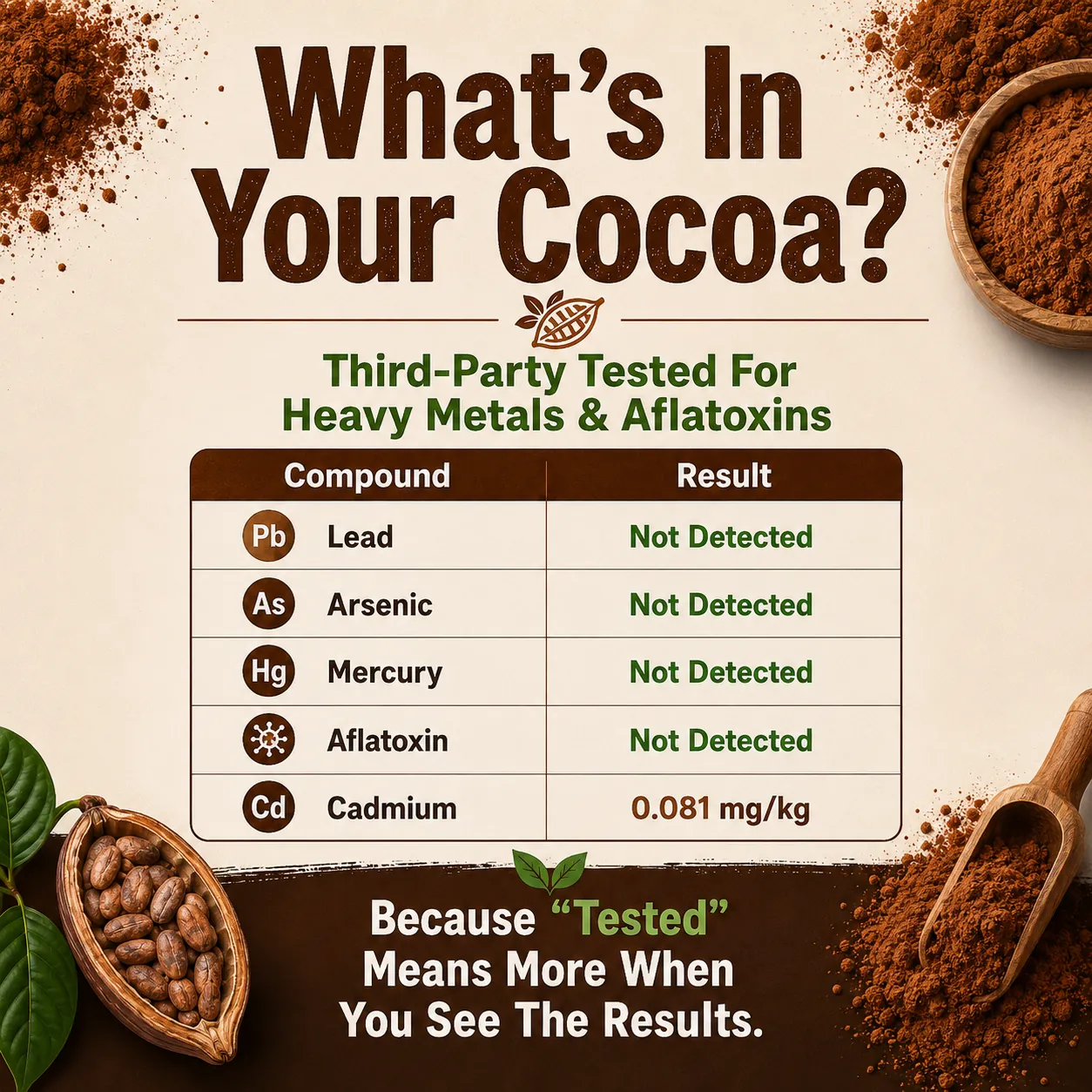
| Cadmium in the cocoa Grevista distributes | 0.081 (≈14% of the EU maximum) | mg/kg | TSL Science report TSL1220400349-1, April 2022 (producer’s sample) |
| Arsenic, lead and mercury in the same report | not detected, below 0.003 | mg/kg | TSL Science report TSL1220400349-1, April 2022 |
| Cadmium in a 6 g serving of that cocoa | ≈0.49 (≈12% of the 4.1 µg/day MADL) | µg | Grevista arithmetic from the April 2022 report, September 15, 2026 |
How do cadmium and lead get into cocoa?
They arrive by two different routes, which is why the fixes are different.
| Cadmium (Cd) | Lead (Pb) | |
|---|---|---|
| How it gets in | Absorbed from soil by the tree; ends up inside the bean | Mostly settles on beans and pods after harvest, for example from dust during sun drying |
| What drives the level | Soil and growing region | Post-harvest handling |
| Can the supply chain reduce it? | Mainly by choice of origin (and, in research, soil management) | Largely, through cleaner drying and handling |
This is why levels vary between origins and brands, and why a named origin and a test report matter more than label adjectives.
What have recent tests of cocoa products found?
| Test | What was tested | Main finding |
|---|---|---|
| Consumer Reports, December 2022 | 28 dark chocolate bars | 23 had enough lead, cadmium or both that one ounce a day would exceed the California reference level for at least one metal |
| Consumer Reports, October 2023 | 48 products in 7 categories, including cocoa powder and hot chocolate mixes | 16 (one third) had concerning levels of lead, cadmium or both |
| Hands et al., Frontiers in Nutrition, July 2024 | 72 dark chocolate and cocoa products bought 2014–2022 | 43% exceeded the Prop 65 daily amount for lead and 35% for cadmium; none exceeded it for arsenic |
These are per-serving comparisons with a whole-day reference amount, so they flag products worth attention rather than declaring a single serving harmful.
What limits apply to cadmium and lead in cocoa powder?
| Reference | Value | What it applies to |
|---|---|---|
| European Union, Regulation (EU) 2023/915 | 0.60 mg/kg cadmium | Cocoa powder sold to the final consumer (0.80 mg/kg for chocolate with at least 50% cocoa solids) |
| California Proposition 65 (OEHHA), MADL | 4.1 µg/day cadmium; 0.5 µg/day lead | Daily exposure levels used for Prop 65 warnings; widely used by consumer testers |
| EFSA tolerable weekly intake | 2.5 µg cadmium per kg body weight per week | Whole diet, long-term average |
| U.S. FDA | No maximum level for cadmium or lead in cocoa powder | FDA lists cadmium and lead as food contaminants under review through its Closer to Zero program (focused on foods for babies and young children); its 0.1 ppm lead guidance covers candy likely eaten often by small children |
The EU number is the easiest to compare with a lab report, because both are expressed in milligrams per kilogram of powder.
Why do regulators care about such small amounts of cadmium?
Because cadmium builds up. The European Food Safety Authority’s 2009 opinion describes cadmium as retained mainly in the kidneys and liver, with a biological half-life of 10 to 30 years, and treats the kidney as the organ of concern. That is why limits are framed around long-term weekly or daily intake from the whole diet rather than any single cup. For a cocoa drinker, it means the level in a cocoa you use every day matters more than the level in one you use once a year. Serving sizes and daily habits are covered in how much cocoa powder per day.
How much cadmium is in two tablespoons of cocoa powder?
It is simple arithmetic once you have a lab number. USDA lists a tablespoon of unsweetened cocoa powder as 5.4 g, so two tablespoons weigh about 10.8 g.
| Cadmium in the powder | Cadmium in 2 tbsp (10.8 g) | Share of the 4.1 µg/day Prop 65 MADL |
|---|---|---|
| 0.081 mg/kg (the April 2022 result for the cocoa Grevista distributes) | about 0.87 µg | about 21% |
| 0.30 mg/kg | about 3.2 µg | about 79% |
| 0.60 mg/kg (EU maximum) | about 6.5 µg | about 158% |
A cocoa at the EU maximum would exceed the California daily reference amount on its own at two tablespoons a day. That is why “how much cocoa is too much” cannot be answered without knowing which cocoa.
Does organic cocoa powder have fewer heavy metals?
Not reliably. USDA organic rules (7 CFR Part 205) govern how a crop is grown and handled; they do not set heavy-metal limits for cocoa, and cadmium comes from the soil regardless of farming method. In the 2024 study of 72 products, organic products tended to have higher heavy-metal levels overall. Consumer Reports, summarizing that study, called it a subtle but consistent difference and noted that its own earlier tests had not found significant differences between organic and non-organic chocolate.
The practical conclusion: organic certification can matter to you for other reasons, but it does not stand in for a heavy-metal test. The cocoa Grevista distributes does not carry USDA Organic certification, and we do not describe it as organic.
Why do cocoa powder and dark chocolate test higher than milk chocolate?
Cadmium and lead sit in the cocoa solids. Cocoa powder is almost entirely cocoa solids, and dark chocolate contains far more of them than milk chocolate, which dilutes the cocoa with sugar, milk powder and cocoa butter. Milk chocolate does not contain “cleaner” cocoa, just less of it per bite. See cocoa powder vs dark chocolate for the full comparison.
How do you read a heavy-metal lab report?

- A named laboratory, ideally accredited to ISO/IEC 17025, which means its competence for that test method has been assessed by an outside body.
- A reference number and a date, so the document can be traced.
- What sample was tested. A report on beans is not a report on powder, and a single sample is not every batch.
- The method and the limit of detection. “Not detected” only means something next to its detection limit: below 0.003 mg/kg is a strong result; below 0.5 mg/kg says little.
- A number with a unit, such as 0.081 mg/kg, rather than the word “passed”.
The same checks, plus label and taste checks, are in how to tell if cocoa powder is pure.
When is this page not enough, and who should not rely on it?
This page explains where the numbers come from; it does not tell you whether a given amount of cocoa is safe for you. Do not use it as medical advice, and ask a clinician instead if you are pregnant or breastfeeding, buying for a young child, living with kidney disease, or already exposed to cadmium at work — those groups have different considerations than a general adult diet. A published report also cannot answer two things: what is in your bag (a report describes the sample tested on a date, not your lot) and how much cadmium you get from the rest of your diet, which is where most intake comes from. If you need lot-level assurance, ask the seller for a batch certificate of analysis rather than a marketing page.
What does the report on Grevista’s cocoa show?
Low measured heavy metals, with the numbers: in an April 2022 third-party lab report (TSL Science, accredited to ISO/IEC 17025:2017), cadmium measured 0.081 mg/kg, about 14% of the EU maximum level of 0.60 mg/kg for cocoa powder sold to consumers, and arsenic, lead and mercury were not detected (below 0.003 mg/kg). Aflatoxins were not detected (below 0.45 µg/kg).
- A 6 g serving works out to about 0.49 µg of cadmium and less than 0.018 µg of lead (our arithmetic).
- The report describes one sample submitted by the producer, VNCACAO CO., LTD (Tbros), in 2022. It is not a certificate of analysis for the lot on sale today.
- Every page of the report, with reference numbers, is on the full lab reports and award records page.
The cocoa is unsweetened, non-alkalized single-origin Vietnamese Trinitario cocoa, sold on Amazon. The 200 g pouch is the smallest size.
Frequently asked questions
Is there a U.S. limit for heavy metals in cocoa powder?
No federal maximum exists for cadmium or lead in cocoa powder. The most useful reference points are the EU maximum of 0.60 mg/kg cadmium for cocoa powder sold to consumers and California’s Prop 65 daily levels of 4.1 µg cadmium and 0.5 µg lead.
Does cocoa powder have lead?
It can. Lead usually gets onto cacao after harvest, so levels vary with drying and handling. A lab report for the specific product is the only way to know the number.
Why is cadmium in cocoa powder?
The cacao tree takes cadmium up from the soil, and it accumulates in the beans. Some growing regions have naturally higher soil cadmium than others.
Does organic cocoa powder have less cadmium?
Not reliably. Organic rules do not set heavy-metal limits, and a 2024 study of 72 products found organic products tended to have higher levels overall.
Which cocoa powder has the lowest heavy metals?
We have not tested other brands, so we cannot rank them. Compare products by their published reports: cadmium in mg/kg, lead with its detection limit, the lab, the date and what sample was tested.
What should you read or do next?
- Lab Results & Awards — open this first if you want to see the full reports, reference numbers and detection limits behind every figure quoted above.
- How much cocoa powder per day — read this next if your real question is how much of a daily cocoa habit is reasonable.
- How to tell if cocoa powder is pure — read this if you are about to compare bags in a store and need checks that work without a report.
- Best cacao powder — read this if you have decided to switch brands and want the criteria in buying order.
- Cocoa powder vs dark chocolate — read this if you get most of your cocoa from chocolate bars rather than powder.
Want a cocoa whose heavy-metal report is published in full, with numbers and detection limits? The Grevista 200 g (7 oz) unsweetened, non-alkalized cocoa powder.
Sources
- Consumer Reports. Lead and Cadmium Could Be in Your Dark Chocolate, December 2022, checked September 15, 2026.
- Food Safety Magazine. Consumer Reports Finds High Levels of Cadmium, Lead in One-Third of Chocolate Products (Consumer Reports testing published October 2023), checked September 15, 2026.
- Hands JM, Anderson ML, Cooperman T, Balsky JE, Frame LA. A multi-year heavy metal analysis of 72 dark chocolate and cocoa products in the USA. Front Nutr. July 31, 2024.
- Consumer Reports. Lead and Cadmium Are Common in Chocolate, Especially Organic, updated July 31, 2024, checked September 15, 2026.
- European Commission. Commission Regulation (EU) 2023/915, April 25, 2023.
- California OEHHA. Proposition 65 No Significant Risk Levels and Maximum Allowable Dose Levels, checked September 15, 2026.
- EFSA Panel on Contaminants in the Food Chain. Cadmium in food. EFSA Journal. 2009;980; and Statement on tolerable weekly intake for cadmium. 2011;9(2):1975.
- U.S. Food and Drug Administration. Cadmium in Food and Foodwares and Lead in Food and Foodwares, checked September 15, 2026.
- U.S. Code of Federal Regulations. 7 CFR Part 205, National Organic Program (current text on eCFR).
- U.S. Department of Agriculture. FoodData Central: Cocoa, dry powder, unsweetened (FDC ID 169593), checked September 15, 2026.
- TSL Science Co., Ltd. Test report TSL1220400349-1, issued April 7, 2022. Published on our Lab Results & Awards page.
Written by the Grevista Editorial Team. This article explains published research and regulations; it is not medical advice. Last updated September 15, 2026. How we check facts: Editorial Policy.