
Lab results & awards
Lab results and awards, published in full
“Pure” and “high quality” should be numbers you can check, not slogans. Every report and award record behind the cocoa Grevista distributes, with its date, laboratory, reference number and method.

Heavy metals tested
Arsenic, cadmium, lead, mercury
All four not detected in an independent third-party lab report, October 2026. Aflatoxins also not detected.
2× Bronze · Silver
Awards, 2018 and 2019
Academy of Chocolate Awards (London) and Hot Chocolate Awards at Chocoa (Amsterdam), awarded to the producer VNCACAO (Tbros).
100% Trinitario
Single origin · Đắk Lắk, Vietnam
One ingredient: natural, non-alkalized cocoa from Trinitario cacao grown without synthetic pesticides or chemical fertilizers and fermented in wooden boxes lined with banana leaves.

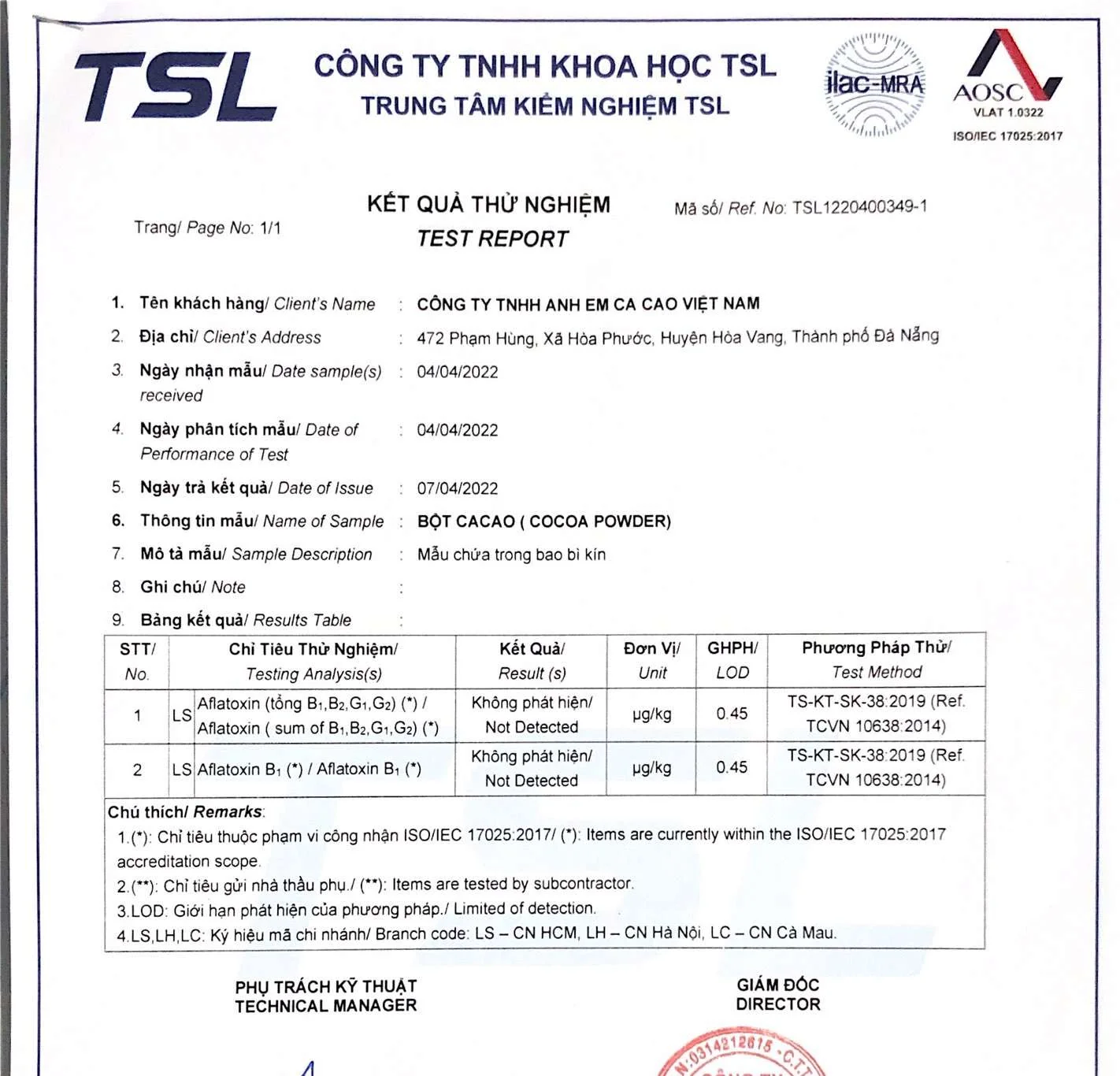
The short answer: in a VietLabs test report (ISO/IEC 17025) issued October 23, 2026, arsenic, cadmium, lead and mercury were all not detected in a sample of this cocoa powder, with cadmium below 0.015 mg/kg. In an earlier report (TSL Science, April 2022), total aflatoxins and aflatoxin B1 were not detected at 0.45 µg/kg. The producer’s Tbros cocoa powder also received two Bronze awards at the Academy of Chocolate Awards 2018, and the producer received a Silver at the Hot Chocolate Awards at Chocoa, Amsterdam, in 2019.
The cocoa is produced in Vietnam by VNCACAO CO., LTD (also listed as VN Cacao / Vietnam Brother Cacao) under its Tbros label. Grevista sources and distributes it in the United States. This page holds our latest heavy metal report for this cocoa powder, our earlier test reports and the awards the producer has earned. We publish them in full so you can check them yourself.
What did the heavy metal and aflatoxin test find?
If you are comparing cocoa powder tested for heavy metals, or looking for a low heavy metal cocoa powder, the details that matter are the laboratory, the date, the sample, the result for each metal and the detection limit. Here they are for this cocoa.
Heavy metals: VietLabs analysis center, Ho Chi Minh City (ISO/IEC 17025:2017 accredited parameters, method AOAC 2015.01) · report VLAB0-261015-070/1 · Report issued: October 23, 2026 · Sample: Grevista cocoa powder
Aflatoxins: TSL Science Co., Ltd (ISO/IEC 17025:2017) · report TSL1220400349-1 · issued April 7, 2022
| Test | Result | Unit | Limit of quantification | Report |
|---|---|---|---|---|
| Arsenic (As) | Not detected | mg/kg | 0.03 | VietLabs, October 23, 2026 |
| Cadmium (Cd) | Not detected | mg/kg | 0.015 | VietLabs, October 23, 2026 |
| Lead (Pb) | Not detected | mg/kg | 0.05 | VietLabs, October 23, 2026 |
| Mercury (Hg) | Not detected | mg/kg | 0.02 | VietLabs, October 23, 2026 |
| Aflatoxins, total (B1, B2, G1, G2) | Not detected | µg/kg | 0.45 (detection limit) | TSL Science, April 7, 2022 |
| Aflatoxin B1 | Not detected | µg/kg | 0.45 (detection limit) | TSL Science, April 7, 2022 |
The complete two-page VietLabs report (VLAB0-261015-070/1) is shown below as issued. Download the full report (PDF).


How do these results compare with regulatory reference levels?
The United States has no federal maximum for cadmium in cocoa powder. The European Union has one: under Commission Regulation (EU) 2023/915, cocoa powder sold to the final consumer may contain no more than 0.60 mg/kg of cadmium. In the October 2026 report, cadmium was not detected, below 0.015 mg/kg, which is under 3% of that limit. That is why we describe this cocoa as having low measured heavy metals, always alongside these numbers.
| Measure | This cocoa (October 2026 report) | Reference level | Reference source |
|---|---|---|---|
| Cadmium, concentration | not detected (below 0.015 mg/kg) | 0.60 mg/kg maximum for cocoa powder sold to the final consumer | Commission Regulation (EU) 2023/915 |
| Cadmium, per 6 g serving | under 0.09 µg | 4.1 µg/day Maximum Allowable Dose Level (MADL) | California Proposition 65 (OEHHA) |
The per-serving figure is the limit of quantification × 6 g, with California’s Proposition 65 level listed for reference.
For what these figures mean across brands and for a daily habit, read our guide to heavy metals in cocoa powder and how much cocoa powder per day makes sense.
Why does “not detected” need a number next to it?
“Not detected” means the amount was below the method’s limit of detection or quantification. Not detected at 0.015 mg/kg is a very different result from not detected at 0.5 mg/kg, yet both can be written the same way on a label. When a brand shows you a report, the detection limit is one of the first things worth checking.
What can too much heavy metal in cocoa do to your health?
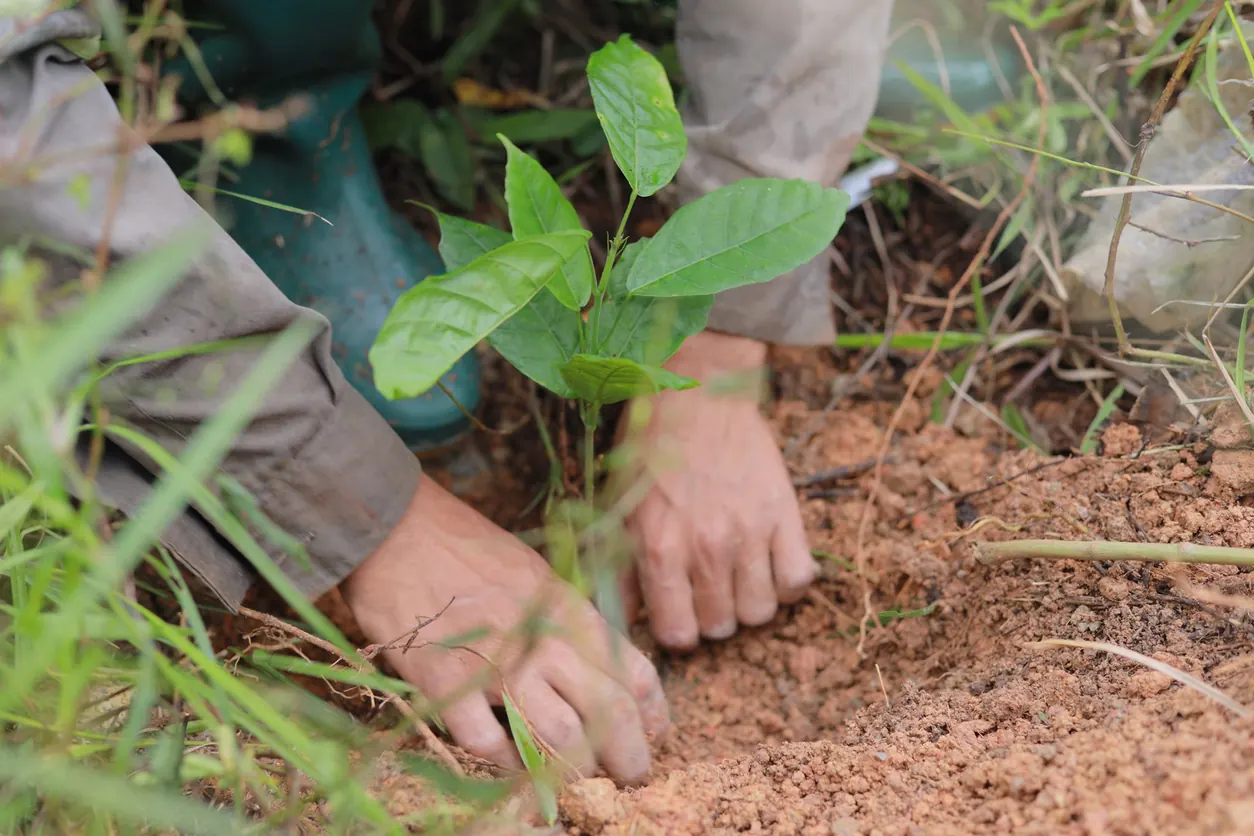
Every cocoa carries traces of metals from the soil it grew in. A single cup is not the concern; what matters is how much builds up over months and years from everything you eat, which is why limits are set for long-term intake. Here is what each metal can do when intake stays too high for too long, next to how this cocoa tested.
| Metal | How it gets into cocoa | What long-term overexposure can do | This cocoa (October 2026) |
|---|---|---|---|
| Cadmium (Cd) | Taken up from the soil by the cacao tree and stored in the bean; fermenting, roasting and milling do not remove it | Builds up in the kidneys, where it stays for decades; over many years, too much can damage the kidneys and weaken bones | Not detected (below 0.015 mg/kg) |
| Lead (Pb) | Mostly from dust and soil that settle on the beans while they dry and are handled after harvest | No level is known to be safe for young children; it can affect brain development, learning and behavior, and in adults it is linked to higher blood pressure and kidney damage | Not detected (below 0.05 mg/kg) |
| Arsenic (As) | From soil and water, usually at very low levels in cocoa | Long-term exposure to inorganic arsenic is linked to skin changes, heart disease and some cancers | Not detected (below 0.03 mg/kg) |
| Mercury (Hg) | Rare in cocoa; most dietary mercury comes from fish | High exposure can harm the nervous system and kidneys, and, before birth, the developing brain | Not detected (below 0.02 mg/kg) |
Sources: WHO, Lead poisoning; WHO, Arsenic; WHO, Mercury and health; EFSA, Cadmium in food (2009); ATSDR, Cadmium ToxFAQs; Consumer Reports, lead and cadmium in dark chocolate; all checked October 22, 2026.
Who should pay the most attention: young children, because they weigh less and their brains are still developing; people who are pregnant; and anyone who has cocoa or dark chocolate every day. For all of them, a cocoa with a published, dated test and low results is the simplest choice.
How much is too much?
Limits come in two forms: a maximum level in the food itself, and a reference amount you can take in over a day or a week from all foods combined.
| Reference | Level | What it means |
|---|---|---|
| EU maximum for cadmium in cocoa powder sold to consumers | 0.60 mg/kg | The highest level allowed in the product (Regulation (EU) 2023/915) |
| EFSA tolerable weekly intake for cadmium | 2.5 µg per kg of body weight per week | About 175 µg a week, or 25 µg a day, for a 70 kg (154 lb) adult, from the whole diet |
| California Proposition 65 MADL for cadmium | 4.1 µg per day | Daily reference level used for warning labels in California |
| California Proposition 65 MADL for lead | 0.5 µg per day | The same, for lead |
What that looks like with two 6 g servings of cocoa a day:
| Cocoa | Cadmium in two servings (12 g) | Share of the Proposition 65 cadmium level |
|---|---|---|
| A cocoa at the EU maximum (0.60 mg/kg) | about 7.2 µg | about 175% |
| This cocoa (not detected, below 0.015 mg/kg) | under 0.18 µg | under 5% |
Because cadmium was below the lab’s limit of quantification, the figures for this cocoa are upper limits. Background on how cocoas compare across brands is in our guide to heavy metals in cocoa powder.
How can you keep heavy metals low when you enjoy cocoa every day?
- Choose a tested cocoa. Look for a published, dated report that lists cadmium and lead with their detection limits, like the one on this page.
- Keep everyday amounts sensible. One to two tablespoons a day covers most drinks and recipes; see how much cocoa powder per day.
- Mix your sources. Vary the chocolate products you eat across the week rather than relying on one untested product.
- Use smaller portions for children, and a cocoa with low published results.
- Remember that processing does not remove cadmium. Natural or Dutch-process, the level comes from the bean, so the test result is what counts.
What were the polyphenol and epicatechin results?
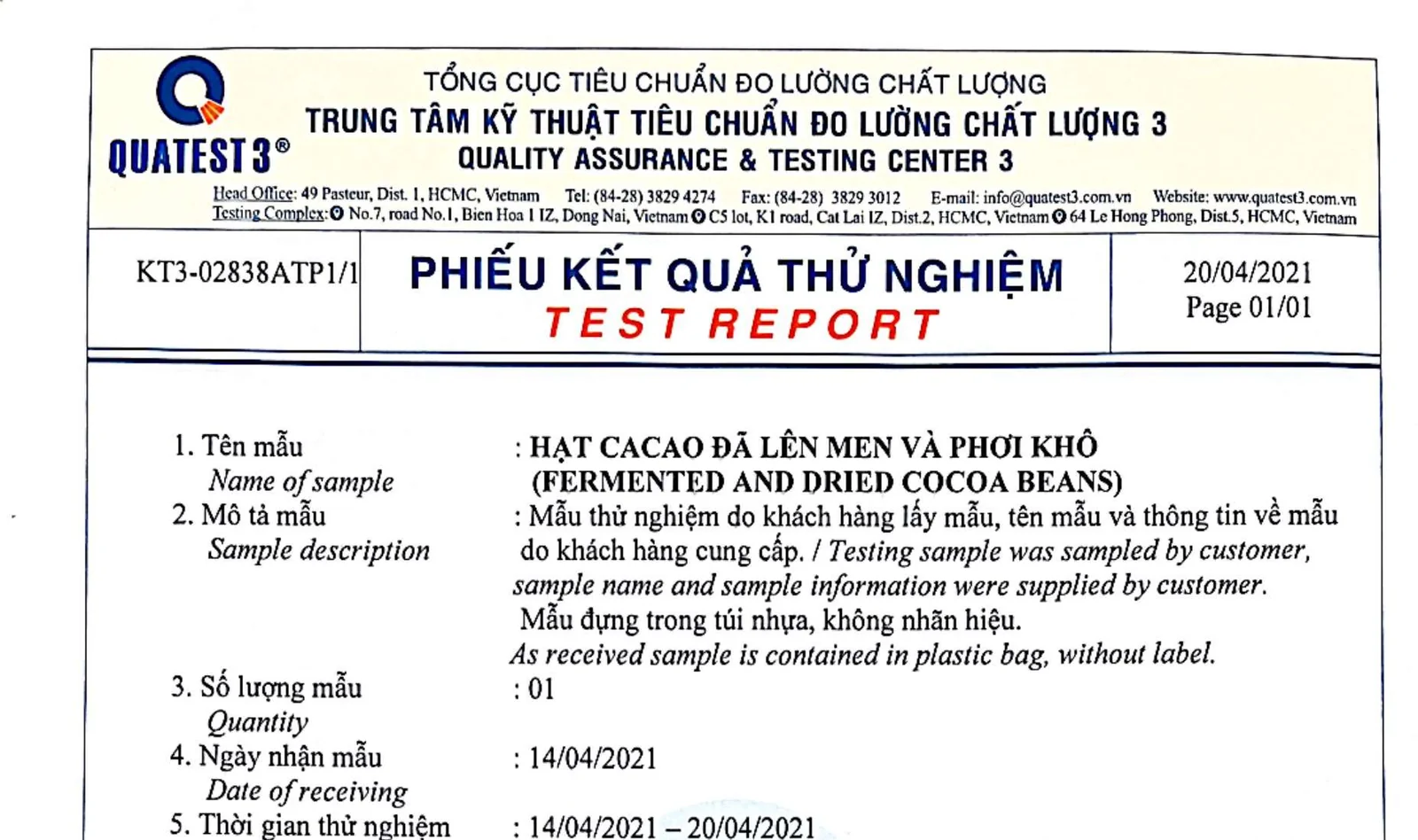
Total polyphenols were measured by the Quality Assurance and Testing Center 3 (Quatest 3), Directorate for Standards, Metrology and Quality, Vietnam.
Report reference: KT3-02838ATP1/1 · Received: April 14, 2021 · Tested: April 14–20, 2021 · Issued: April 20, 2021
Sample: fermented and dried cocoa beans, the beans this powder is milled from
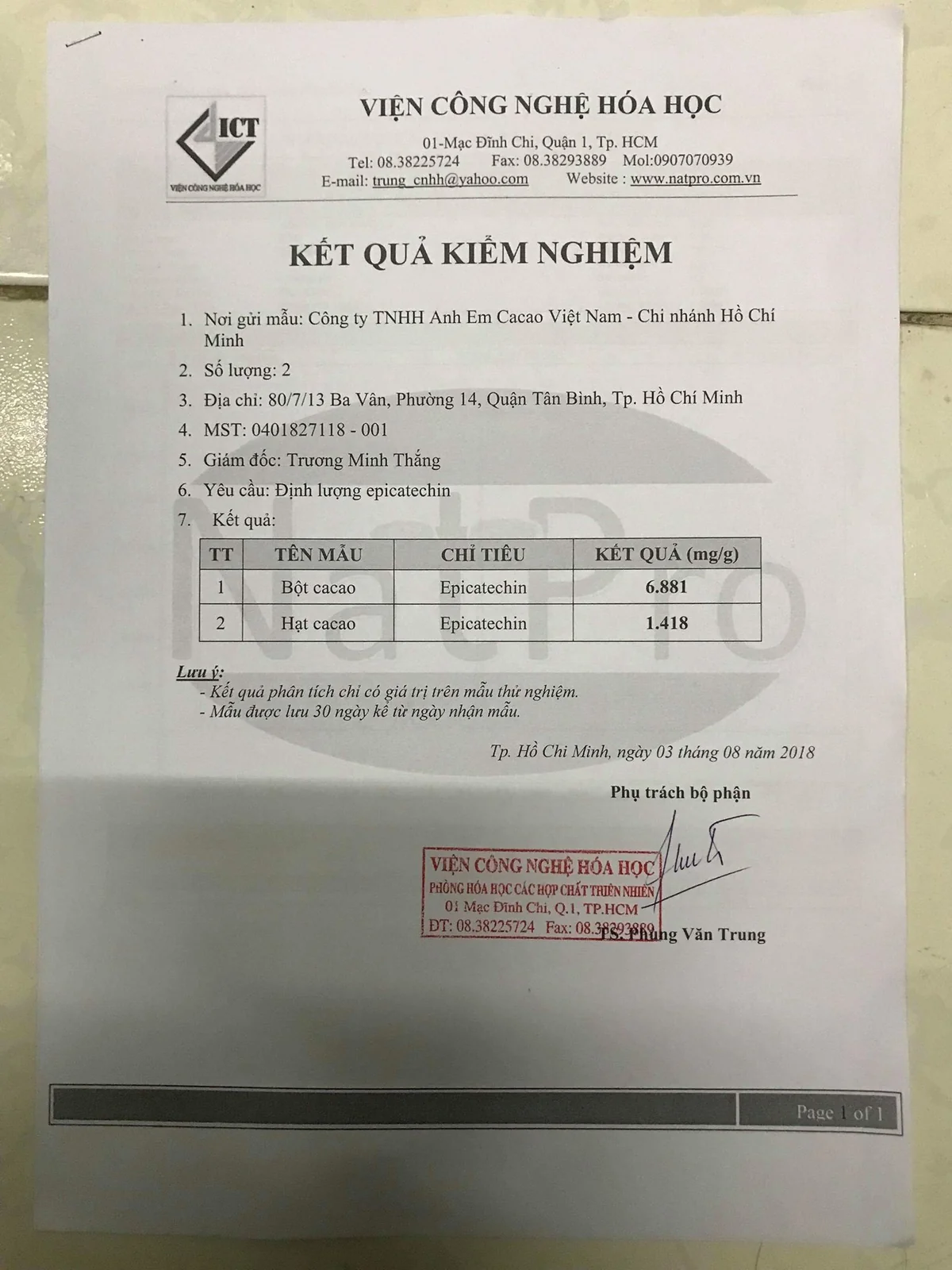
Epicatechin was measured by the Institute of Chemical Technology, Ho Chi Minh City, Vietnam.
Issued: August 3, 2018 · Samples: cocoa powder and cocoa beans (two samples submitted)
| Test | Result | Unit | Sample | Laboratory and date |
|---|---|---|---|---|
| Total polyphenols (ISO 14502-1:2005) | 3.89 | g / 100 g | Fermented, dried cocoa beans | Quatest 3, April 2021 |
| Epicatechin | 6.881 | mg / g | Cocoa powder | Institute of Chemical Technology, August 2018 |
| Epicatechin | 1.418 | mg / g | Cocoa beans | Institute of Chemical Technology, August 2018 |
What this works out to per serving: a 6 g tablespoon of the powder carries about 40 mg of epicatechin. Read more in epicatechin in cocoa powder.
Why process matters: alkalizing (Dutch-processing) raises the pH of cocoa to mellow its flavor and darken its color, and it lowers flavanol content. In a 2008 analysis of commercial cocoa powders published in the Journal of Agricultural and Food Chemistry, natural cocoas averaged 34.6 mg/g total flavanols, compared with 13.8 mg/g for lightly, 7.8 mg/g for medium and 3.9 mg/g for heavily alkalized cocoas. This cocoa is non-alkalized.
Which awards are behind this cocoa?
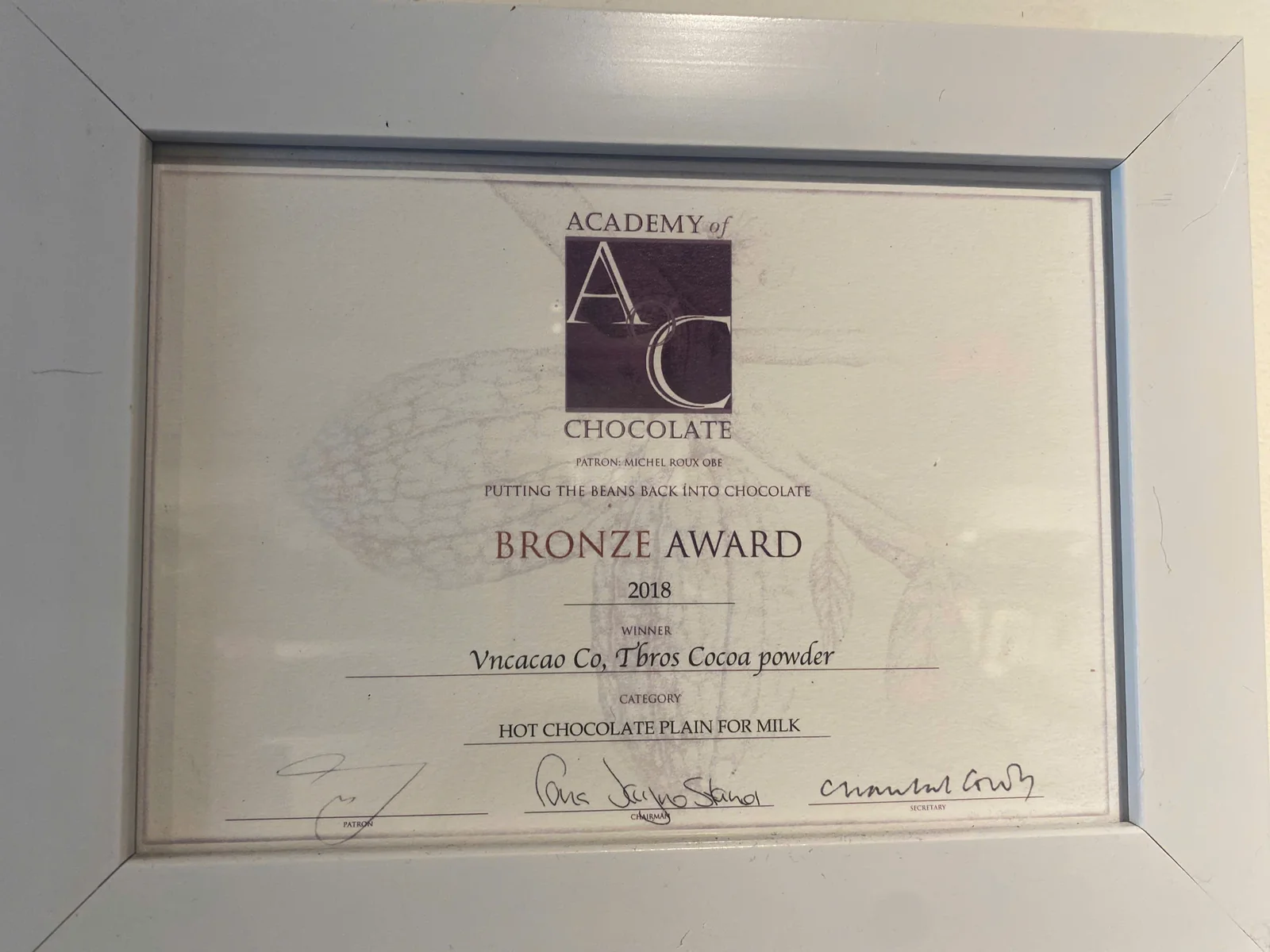
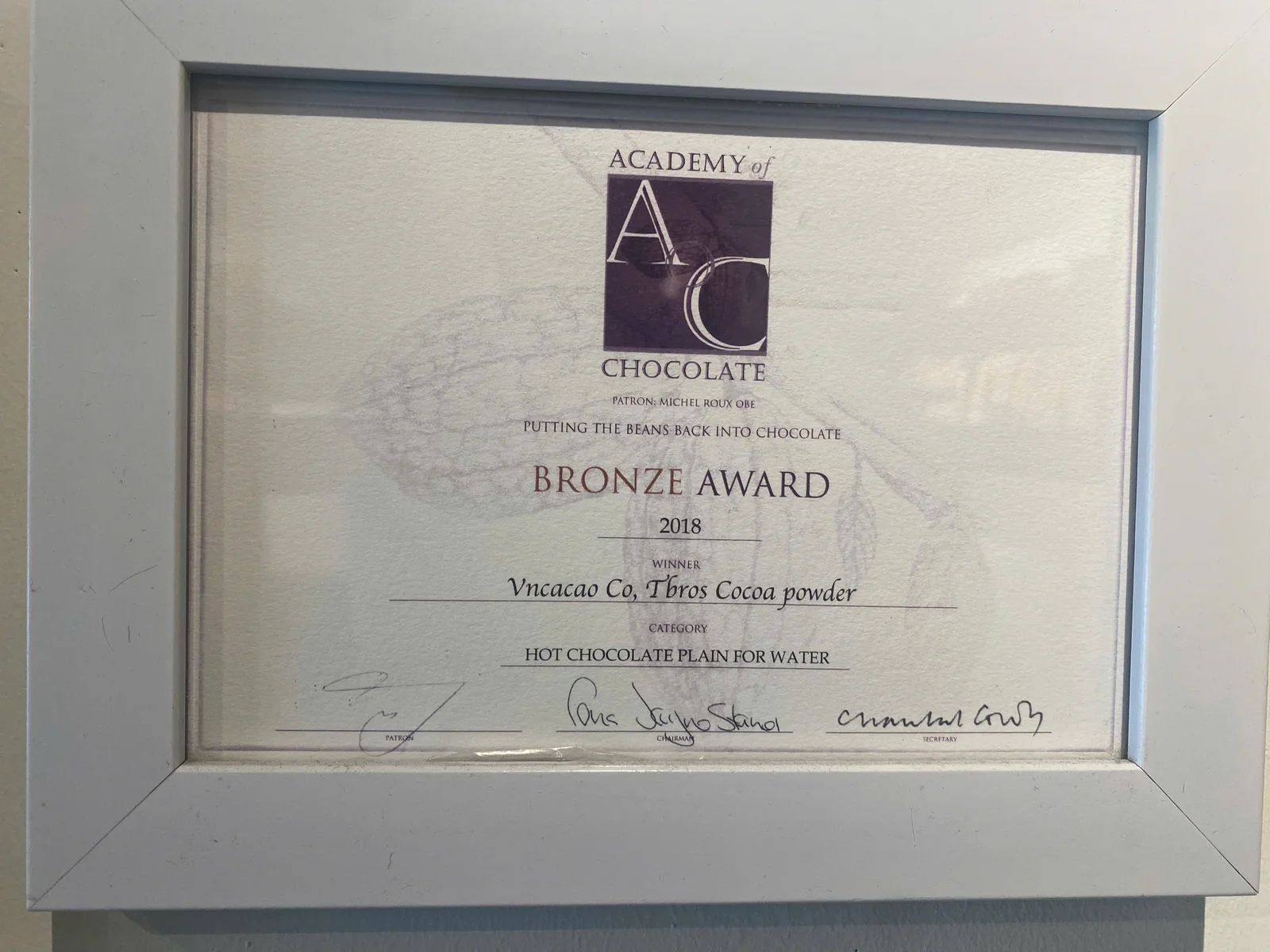
Three awards to the producer, all in hot chocolate categories. The two 2018 Bronze awards name the Tbros cocoa powder; the 2019 Silver certificate names the producer.
| Competition | Result | Category | Date | How to verify |
|---|---|---|---|---|
| Academy of Chocolate Awards (London, UK) | Bronze | Hot Chocolate – Plain, for Milk (results page: Drinking Chocolate, “Plain, for milk-based drinks”). Entrant: Vncacao Co. (Tbros cocoa powder) | 2018 | Official 2018 results |
| Academy of Chocolate Awards (London, UK) | Bronze | Hot Chocolate – Plain, for Water (results page: Drinking Chocolate, “Plain, for water emulsion”). Entrant: Vncacao Co. (Tbros cocoa powder) | 2018 | Official 2018 results |
| Hot Chocolate Awards at Chocoa (Amsterdam, Netherlands) | Silver | Hot chocolate. Awarded to the producer, VNCACAO CO., LTD (Tbros) | February 24, 2019 | Certificate reproduced below |
How can you check the Academy of Chocolate awards for this cocoa powder yourself?
- Open the Academy of Chocolate’s 2018 awards page.
- Scroll to the Drinking Chocolate section.
- Look for the entry “VNCACAO CO, LTD — Tbros Cocoa powder”. It appears twice, with a Bronze under Plain, for water emulsion and a Bronze under Plain, for milk-based drinks.
The 2019 Silver at Chocoa is shown by the certificate below.

What does an award measure?
Taste. Judges assess flavor, aroma and texture, and the laboratory reports on this page cover composition and contaminants, so together they give the full picture.
Where can you download the full reports?
The heavy metal results are summarized in the image above. TSL Science and Quatest 3 require their reports to be reproduced in full, so the aflatoxin and polyphenol documents below are complete and unedited.
- Aflatoxin test report (PDF) — TSL Science · ref TSL1220400349-1 · issued April 7, 2022 · aflatoxin B1 and total aflatoxins
- Total polyphenols test report (PDF) — Quatest 3 · ref KT3-02838ATP1/1 · issued April 20, 2021 · ISO 14502-1:2005
The epicatechin report (2018) is shown above.
How should you read these reports?
- Each report records the sample and the date tested: epicatechin in 2018 on cocoa powder and beans, total polyphenols in 2021 on fermented, dried beans, aflatoxins in 2022 and heavy metals in October 2026 on cocoa powder.
- They measure composition and contaminants in the samples tested.
You can read more about who we are and who makes the cocoa.
Frequently asked questions
What was this cocoa powder tested for?
Arsenic, cadmium, lead and mercury in a VietLabs test report (ISO/IEC 17025) issued October 23, 2026, and total aflatoxins and aflatoxin B1 by TSL Science in April 2022. Separate reports cover total polyphenols (Quatest 3, 2021, on beans) and epicatechin (Institute of Chemical Technology, 2018).
Was the cocoa powder tested for lead and cadmium?
Yes. In the VietLabs report issued October 23, 2026, lead was not detected (below 0.05 mg/kg) and cadmium was not detected (below 0.015 mg/kg). Arsenic and mercury were also not detected.
Is this cocoa powder low in heavy metals?
Based on the October 2026 report, it has low measured heavy metals: arsenic, cadmium, lead and mercury were all not detected, with cadmium below 0.015 mg/kg, under 3% of the EU maximum of 0.60 mg/kg for cocoa powder sold to consumers.
Is it a low cadmium cocoa powder?
Cadmium was not detected (below 0.015 mg/kg), which works out to under 0.09 µg in a 6 g serving; California’s Proposition 65 MADL for cadmium is 4.1 µg per day.
How much cadmium is in the cocoa powder?
None detected: the October 2026 report gives cadmium below 0.015 mg per kilogram for the sample tested. The EU maximum for cocoa powder sold to consumers is 0.60 mg/kg.
What does “award-winning cocoa powder” mean here?
Specifically: two Bronze awards at the Academy of Chocolate Awards 2018 for the producer’s Tbros cocoa powder, in plain hot chocolate categories made with milk and with water, and a Silver to the same producer at the Hot Chocolate Awards at Chocoa in 2019. Judges assess taste; an award says nothing about contaminants, which is why the lab reports sit beside it.
Did Grevista win these awards?
No. The two 2018 Bronze awards went to the producer, VNCACAO CO., LTD, for its Tbros cocoa powder, and the 2019 Silver went to the same producer. Grevista distributes the producer’s cocoa powder in the United States.
Where can I buy it?
It is sold and fulfilled through Amazon. You can compare the 200 g box and the 250 g and 500 g luxury gift boxes on the Grevista Pure Trinitario Cocoa Powder in three sizes page.
Related reading
- Heavy metals in cocoa powder: what testing shows across brands and how to read a report.
- Academy of Chocolate Awards explained: how the awards work and what a medal does and does not prove.
- How much cocoa powder per day: what a sensible daily amount looks like.
- The best cocoa powder for hot chocolate: what to look for in a cocoa for drinks.
- The complete cocoa powder guide: every topic, from processing to recipes.
Sources
- VietLabs test report VLAB0-261015-070/1 (arsenic, cadmium, lead, mercury; ISO/IEC 17025:2017 accredited parameters, AOAC 2015.01), issued October 23, 2026. Full report above.
- TSL Science Co., Ltd. Test report TSL1220400349-1 (aflatoxins), issued April 7, 2022. Downloadable above.
- Quatest 3. Test report KT3-02838ATP1/1 (total polyphenols), issued April 20, 2021. Downloadable above.
- Institute of Chemical Technology, Ho Chi Minh City. Epicatechin report, issued August 3, 2018.
- Academy of Chocolate. 2018 Awards results, checked September 15, 2026.
- European Commission. Commission Regulation (EU) 2023/915 on maximum levels for certain contaminants in food, April 25, 2023.
- California Office of Environmental Health Hazard Assessment (OEHHA). Proposition 65 Maximum Allowable Daily Level for cadmium (4.1 µg/day); lead MADL 0.5 µg/day, checked September 15, 2026.
- Miller KB et al. Impact of alkalization on the antioxidant and flavanol content of commercial cocoa powders. J Agric Food Chem. 2008;56(18):8527–8533.
Written by the Grevista Editorial Team. Last updated October 28, 2026. How we check facts: Editorial Policy.