Back to the Cocoa Powder Guide
Cacao and cocoa come from the same plant, Theobroma cacao, and the powders are made the same basic way: beans are fermented, dried, pressed to remove most of the fat, and milled. In U.S. regulations, “cocoa” is the standardized name for that powder (21 CFR Part 163). “Cacao powder” has no separate legal definition; brands usually use it to signal a less processed product, such as one made from unroasted or lightly roasted beans.
The differences that change flavor and composition come from processing, not the spelling: how the beans were roasted, whether the powder was alkalized (Dutch-processed), and whether anything was added. When comparing cacao powder vs cocoa powder, read the ingredient list and look for “non-alkalized” rather than trusting the name.
Key facts: cacao powder vs cocoa powder side by side
| What | Cacao powder | Cocoa powder | Source and date |
|---|---|---|---|
| Legal definition in the U.S. | none | standardized name, 21 CFR §163.113 | eCFR, checked September 15, 2026 |
| Plant | Theobroma cacao — the same species for both | 21 CFR Part 163, checked September 15, 2026 | |
| Flavanols, non-alkalized vs heavily alkalized (averages) | 34.6 vs 3.9 mg/g — set by alkalizing, not by the name | Miller et al., J Agric Food Chem, 2008 | |
| Sugars in 1 tbsp (5.4 g), unsweetened | ≈0.1 g | USDA FoodData Central FDC 169593, checked September 15, 2026 | |
| Temperature the bean mass reaches during fermentation alone | 113–122 °F (45–50 °C) | Front Sustain Food Syst, 2022, checked September 15, 2026 | |
| What actually differs | roasting, alkalizing, added ingredients — read the ingredient list | Grevista editorial conclusion, September 16, 2026 |
What is cacao powder?
Cacao powder is what remains of cacao beans after most of the cocoa butter has been pressed out and the solids have been milled. Every powder on the shelf, whether labeled cacao or cocoa, goes through the same stages:
- Harvest. Pods are opened and the beans are removed in their white pulp.
- Fermentation, usually several days in boxes or heaps. This is where chocolate flavor precursors form, and the bean mass typically reaches 113–122 °F (45–50 °C).
- Drying, often in the sun on raised beds or under cover.
- Roasting (or not) and pressing. Beans are cracked into nibs and pressed; most of the fat leaves as cocoa butter, and a hard cake remains.
- Milling, with or without alkalizing. The cake is ground into powder. Some producers treat it with alkali to darken and mellow it.
What is the difference between cacao and cocoa powder on a label?
| What people often assume | What the label actually guarantees |
|---|---|
| “Cacao” means unprocessed | Every powder is fermented, dried, pressed and milled. “Cacao” is a marketing choice, not a processing standard. |
| “Cacao” has more flavanols | Only if it is not alkalized and not heavily processed. An alkalized powder labeled cacao loses flavanols like any other. |
| “Cocoa” means lower quality | “Cocoa” is simply the regulated U.S. name. Many carefully made natural powders are sold as cocoa. |
| The name tells you how it was processed | It does not. “Natural” or “non-alkalized” versus “processed with alkali” in the ingredients does. |
Is raw cacao powder really raw?
There is no U.S. legal definition of “raw” for cacao. Even unroasted beans are fermented, and fermentation alone warms the bean mass to around 113–122 °F (45–50 °C). “Unroasted” can be accurate; “raw” is hard to verify. If the claim matters to you, ask the brand what temperatures the beans reach. We look at what “raw” usually means in practice in our article on raw cacao powder.
Does cacao powder have more flavanols than cocoa powder?
The processing decides it. In a 2008 analysis of commercial powders, natural (non-alkalized) cocoa averaged 34.6 mg/g of total flavanols, while heavily alkalized cocoa averaged 3.9 mg/g. A powder labeled “cacao” that has been alkalized is on the low side of that range; a natural powder labeled “cocoa” is on the high side. For flavanols, “non-alkalized” is the useful word. The details are in natural vs Dutch-process cocoa powder.
Which tastes better, and can you swap them?
| Natural (non-alkalized) cacao or cocoa | Alkalized (Dutch-process) cocoa | |
|---|---|---|
| Flavor | brighter, fruitier, more bitter edge | smoother, mellower |
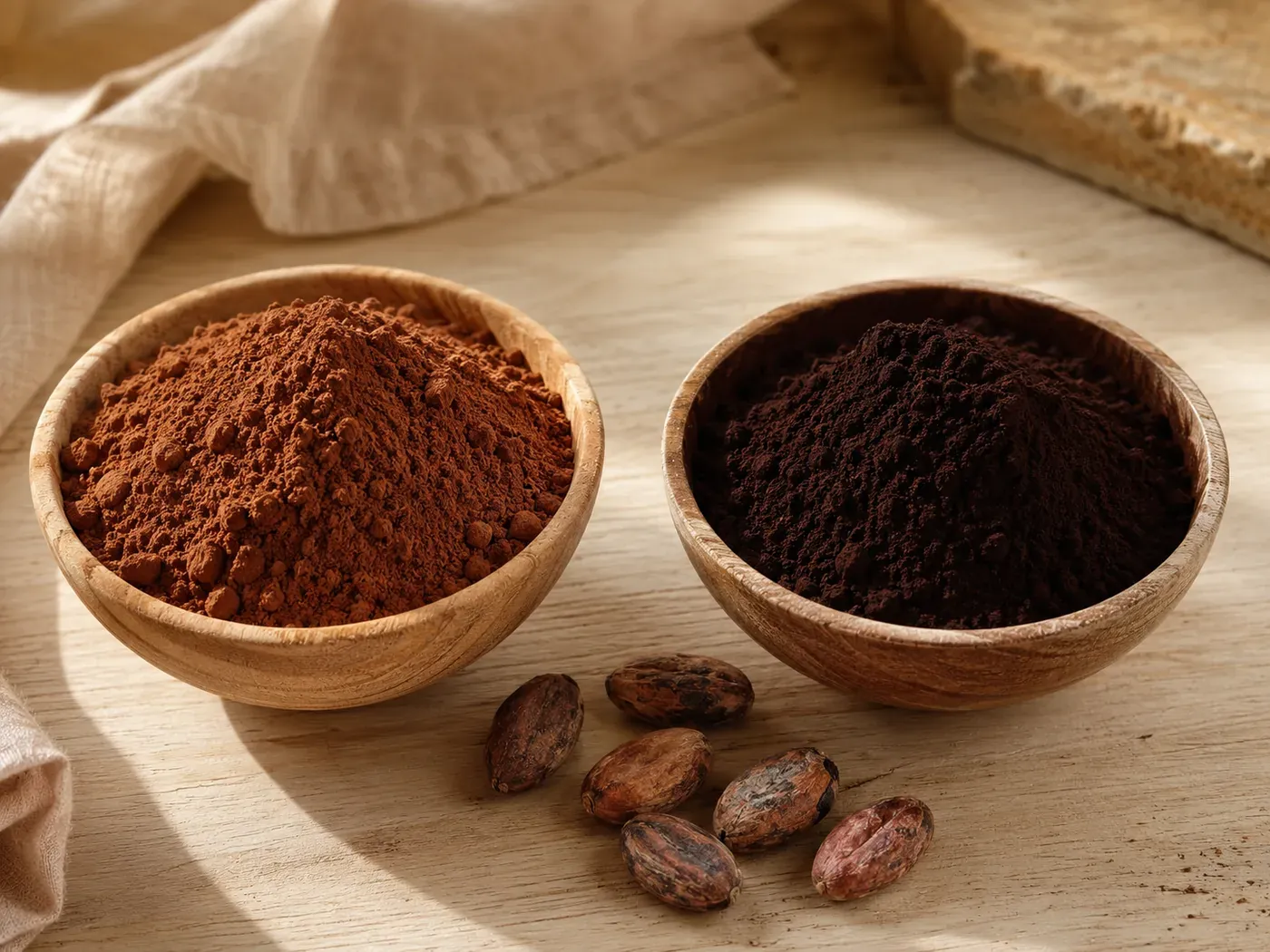
| Color | lighter, reddish-brown | dark brown to near-black |
| Drinks and smoothies | swap freely | swap freely |
| Baking with baking soda | works (its acidity activates the soda) | may rise poorly without another acid |
Unsweetened cacao powder and natural cocoa powder behave the same way in recipes. If you have cacao nibs rather than powder, they are a different ingredient; see cocoa powder vs cacao nibs.
What should you check instead of the name?
- One ingredient: cocoa or cacao, nothing else.
- Natural or alkalized, from the ingredient list.
- A named origin and producer, because cadmium levels depend on where the cacao grew.
- A published lab report with the lab name, date and numbers for cadmium and lead.
- Price per ounce, since the same kind of powder can cost more under the “cacao” name.
When is a powder labeled “cacao” the wrong buy?
Skip a bag labeled cacao if your recipe was written for Dutch-process cocoa and relies on baking powder alone; if you want a very dark crumb, since most cacao powders are non-alkalized and lighter; if you are paying a premium purely for the word and the bag carries no origin, producer or lab report; or if you wanted nibs, chocolate or a sweetened drink mix, which are different products. In those cases a Dutch-process cocoa, a black cocoa or the right product category is the better purchase.
Why does Grevista call its powder cocoa?
Because the beans are fermented and roasted before milling, and “cocoa” is the accurate, regulated name for that powder. What matters more is measurable: it is non-alkalized, unsweetened, single-origin Vietnamese Trinitario cocoa with one ingredient, made by VNCACAO CO., LTD (Tbros), and its lab reports are published in full. If you want to taste a natural cocoa in your own recipes, start with our 200 g pouch of non-alkalized cocoa powder, or check the 200 g pouch price.
Frequently asked questions
Is cacao powder the same as cocoa powder?
They come from the same bean and are made by the same basic steps. The name “cacao” usually signals less roasting, but the label does not guarantee it; check whether the powder is alkalized and what the ingredient list says.
Is cacao healthier than cocoa?
The name does not decide composition. Flavanol content depends mostly on processing, especially alkalizing, and non-alkalized powders keep more whether they are labeled cacao or cocoa.
Can I use cacao powder instead of cocoa powder in baking?
Yes, if both are unsweetened. Treat unsweetened cacao powder like natural cocoa: it is acidic and works with baking soda. Do not swap it into a recipe written for Dutch-process cocoa without adjusting the leavening.
Does cacao powder contain sugar?
Unsweetened cacao or cocoa powder contains very little: USDA lists about 0.1 g of sugars in a tablespoon of unsweetened cocoa powder. Anything sweet is a mix, not plain powder.
Why is cacao powder usually more expensive?
Often because of positioning, origin or smaller-scale production. The price alone does not tell you the processing or the heavy-metal level, so compare labels and lab reports.
What should you read or do next?
- Natural vs Dutch-process cocoa powder — read this next, because alkalizing (not the word cacao) is the difference that changes flavor, color and baking.
- Heavy metals in cocoa powder — read this if you assumed “cacao” meant cleaner; neither label tells you the cadmium level.
- Best cacao powder — read this if you now want to shortlist a powder using criteria you can check.
- Raw cacao powder — read this if the word “raw” on the bag is what you were really asking about.
Want a powder whose processing is stated plainly? The Grevista 200 g (7 oz) unsweetened, non-alkalized cocoa powder lists one ingredient and publishes its lab reports.
Sources
- U.S. Code of Federal Regulations. 21 CFR Part 163, Cacao Products (§163.113 cocoa), checked September 15, 2026.
- Miller KB et al. Impact of alkalization on the antioxidant and flavanol content of commercial cocoa powders. J Agric Food Chem. 2008;56(18):8527–8533.
- Box fermentation and solar drying improve the nutrient composition and organoleptic quality of chocolate from cocoa beans. Front Sustain Food Syst. 2022 (fermentation temperatures), checked September 15, 2026.
- U.S. Department of Agriculture. FoodData Central: Cocoa, dry powder, unsweetened (FDC ID 169593), checked September 15, 2026.
Written by the Grevista Editorial Team. Last updated September 15, 2026. How we check facts: Editorial Policy.