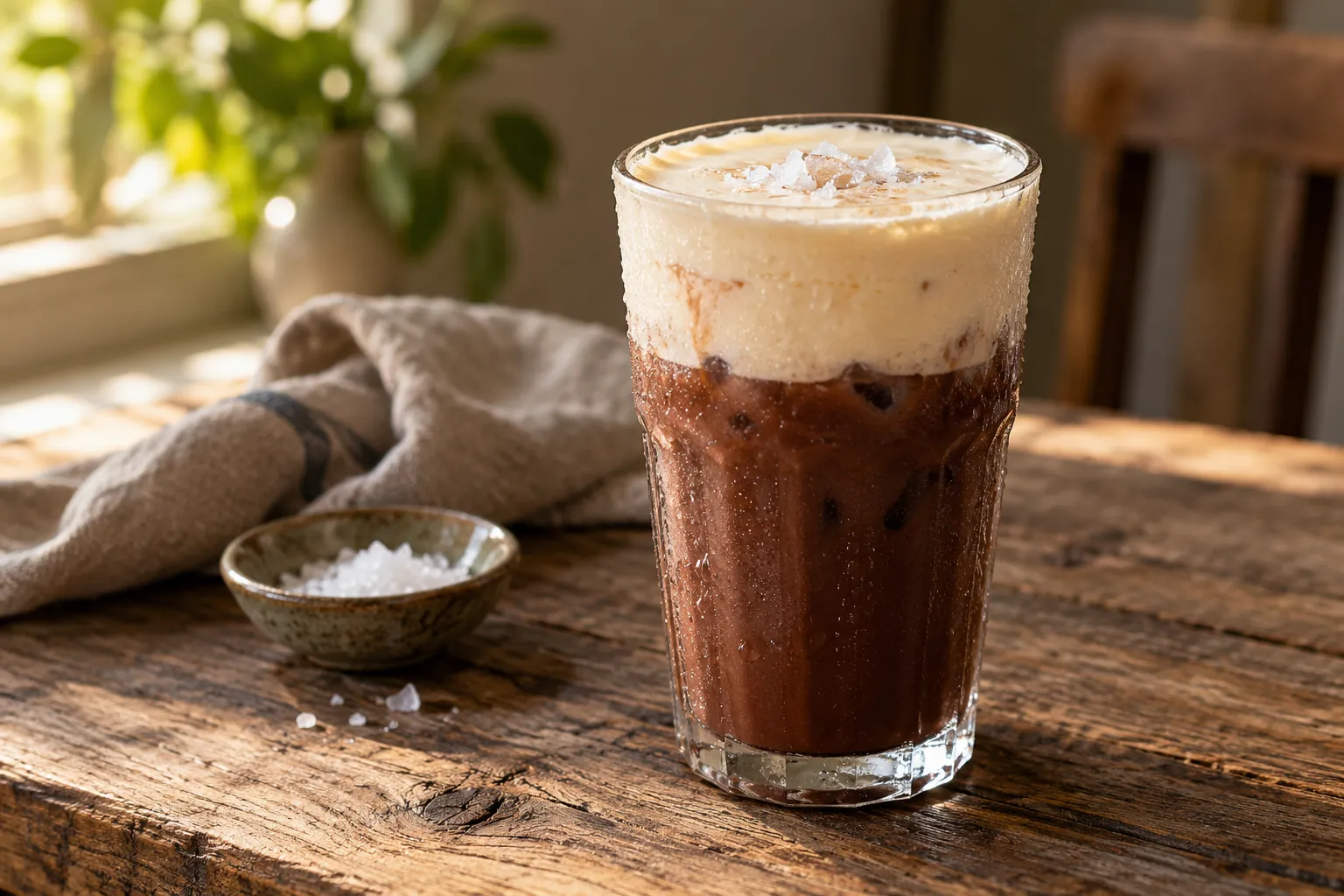
Vietnamese salted cocoa (cacao muối) is cocoa and milk under a cap of lightly salted, sweetened whipped cream that you drink through without stirring. For one mug, whisk 1 tablespoon of cocoa with 2 tablespoons of just-boiled water, add 1 tablespoon of condensed milk and ¾ cup of hot milk, then float cream whipped with condensed milk and ⅛ teaspoon of fine salt. About 10 minutes, hot or iced.
It borrows the method of cà phê muối, the salt coffee from Huế, Vietnam. The salt does not make the drink taste salty; it softens cocoa’s bitterness, so each sip goes salt, then sweet, then cocoa.
Key facts for Vietnamese salted cocoa
| What | Value | Unit | Source and date |
|---|---|---|---|
| Yield | 1 | mug, 1 cup (240 ml) | Grevista recipe, September 15, 2026 |
| Total time | 10 | minutes (5 prep + 5 cook) | Grevista recipe, September 15, 2026 |
| Unsweetened cocoa powder | 1 tbsp (5.4 g) | tbsp (g) | Tablespoon weight from USDA FoodData Central FDC 169593, checked September 15, 2026 |
| Fine salt in the cream cap | ⅛ | tsp per mug | Grevista recipe, September 15, 2026 |
| Hot water for the cocoa paste | 2 | tbsp (30 ml) | Grevista recipe, September 15, 2026 |
| Hot milk | ¾ | cup (180 ml) | Grevista recipe, September 15, 2026 |
| Caffeine per mug | ≈12 | mg | USDA FoodData Central FDC 169593, checked September 15, 2026 |
| Reference: caffeine in an 8 oz (240 ml) coffee | ≈80–100 | mg | FDA, “Spilling the Beans”, checked September 15, 2026 |
| Why salt works: bitterness is suppressed more than sweetness | — | mechanism | Breslin & Beauchamp, Nature 387:563, 1997 |
| Origin of the method (cà phê muối, Huế, Vietnam) | — | context | CNN Travel, checked September 15, 2026 |
The amounts above are published as a recipe, not as the result of a tasting panel.
How do you make Vietnamese salted cocoa?
Makes: 1 mug (about 1 cup / 240 ml) · Prep: 5 minutes · Cook: 5 minutes · Total: 10 minutes
Ingredients: salted cream cap
- 1 tbsp (20 g) sweetened condensed milk
- ⅛ tsp (0.7 g) fine sea salt
- 3 tbsp (45 ml) cold heavy cream
Ingredients: cocoa base
- 1 tbsp (5.4 g) unsweetened cocoa powder
- 2 tbsp (30 ml) just-boiled water
- 1 tbsp (20 g) sweetened condensed milk
- ¾ cup (180 ml) hot milk or oat milk
Instructions
- Salt the condensed milk. Stir the salt into 1 tbsp of condensed milk until dissolved. Salt dissolves in condensed milk but stays gritty in cold cream.
- Whip the cream cap. Add the cold cream and whisk for 30–60 seconds, until it thickens but still pours. Stop before it holds peaks.
- Make the cocoa paste. In a mug, whisk the cocoa with the just-boiled water until completely smooth.
- Build the base. Stir in the second tablespoon of condensed milk, then the hot milk. It should taste slightly under-sweet on its own.
- Cap it. Pour the salted cream slowly over the back of a spoon so it floats as a pale layer.
- Drink without stirring. Sip through the cream so you taste salt, sweetness and cocoa in turn.
How do you make it iced?
Make the cocoa base with 2 tbsp (11 g) cocoa, 2 tbsp (30 ml) just-boiled water and the condensed milk, then stir in only ½ cup (120 ml) cold milk. Pour over a glass of ice and float the salted cream on top. Cold dulls both sweetness and bitterness, so taste the cream; a tiny extra pinch of salt may help.
What is cà phê muối, and how is the cocoa version different?
Cà phê muối is strong Vietnamese coffee under a lightly salted cream made with condensed milk. Its creators told CNN they first served it at their café in Huế in 2010, and it has since spread to cafés outside Vietnam. Cacao muối keeps the same cream cap and drinking method but swaps the coffee for cocoa.
| Salt coffee (cà phê muối) | Salted cocoa (cacao muối) | |
|---|---|---|
| Base | Strong robusta coffee from a phin filter | Unsweetened cocoa, water and milk |
| Caffeine | High | Low: about 12 mg per tablespoon of cocoa (USDA) |
| Flavor | Bitter, roasted | Bitter-fruity cocoa with a creamy base |
| Cream cap | Same: heavy cream, condensed milk and ⅛ tsp salt |
If you want the coffee version with a cocoa note, dust the salted cream with a pinch of cocoa powder. More ways to pair the two are in our guide to cocoa powder for coffee.
Why does salt make cocoa taste better?
Salt suppresses bitterness. In a 1997 study published in Nature, sodium salts reduced the perceived bitterness of bitter compounds, which in turn let sweet and other flavors come forward. Cocoa is naturally bitter and slightly astringent, so a little salt makes the same cup taste rounder and sweeter without more sugar. The Vietnamese twist is keeping the salt in a separate layer, so you taste it first rather than blended in.
How much salt should you use?
About ⅛ teaspoon of fine sea salt per mug. At that amount the salt reads as brightness at the front of the sip, not as seasoning. Coarse salt is hard to measure by volume, so use fine salt or weigh it. If the drink tastes savory, halve the salt next time.
| Problem | Cause | Fix |
|---|---|---|
| Gritty cream | Salt added directly to cold cream | Dissolve the salt in condensed milk first |
| Cream sinks or sits like a lid | Under-whipped or over-whipped | Whip until thick but still pourable |
| Tastes like ordinary hot chocolate | Stirred together | Sip through the cap without stirring |
| Flat, dusty flavor | Lumps in the paste or a dull cocoa | Whisk the paste fully; use a fresh unsweetened cocoa |
Can you make salted cocoa without dairy?
Yes, though it becomes a different drink. Use oat milk for the base and chilled, whipped coconut cream for the cap, with 2 tsp maple syrup in place of the condensed milk in each part. Stir the salt into the maple syrup before whipping. It tastes nuttier and less custardy.
Which cocoa works best in salted cocoa?
This drink has nowhere to hide: no coffee or chocolate bar, just cocoa, milk, cream and salt. Natural (non-alkalized) cocoa keeps a fruity acidity that plays well against the salted cream; Dutch-process cocoa makes a smoother, flatter cup. Use one with a single ingredient on the label. The difference is explained in natural vs Dutch-process cocoa powder, and for the plain version see our hot chocolate recipe with cocoa powder.
When should you not make this drink?
Skip it if you are on a low-sodium diet — the cream cap is the point of the recipe, and removing the salt leaves you with plain cocoa. Skip it too if you dislike sweetened condensed milk, since it carries both the texture and the sugar; if you plan to stir the drink, because stirring destroys the salt-then-sweet-then-cocoa sequence; if you want a large batch, as the cream cap does not hold well and is best whipped per serving; or if you need it dairy-free and do not want a nuttier coconut-cream version.
Want to make it with Vietnamese cocoa?
A Vietnamese drink suits Vietnamese cocoa. The cocoa Grevista distributes is single-origin Vietnamese Trinitario cocoa, unsweetened and non-alkalized, made by VNCACAO CO., LTD (Tbros), whose cocoa won two Bronze medals for drinking chocolate at the Academy of Chocolate Awards 2018. Read more about Vietnamese cocoa.
Frequently asked questions
Does Vietnamese salted cocoa taste salty?
Not at ⅛ teaspoon per mug. You notice a brief brightness at the start of the sip, then sweetness and cocoa.
Do I have to use sweetened condensed milk?
It gives the Vietnamese texture and dissolves the salt. You can use 2 tsp sugar dissolved in 1 tbsp hot water instead, but the cream will be thinner.
Can I put cocoa in salt coffee?
Yes. Dust the cream cap with cocoa, or stir 1 tsp of cocoa into the coffee before adding the salted cream.
Is cacao muối a traditional Vietnamese drink?
The salted cream cap is recent, not centuries old. It comes from cà phê muối, first served in Huế in 2010 according to its creators; the cocoa version applies the same idea to cocoa.
Is salted cocoa caffeine-free?
No, but it is low in caffeine. A tablespoon of cocoa powder contains about 12 mg, according to USDA data, compared with about 80–100 mg in an 8-ounce cup of coffee (FDA).
What should you read or do next?
- Hot chocolate recipe with cocoa powder — go here for the plain base if you want the cocoa without the cream cap.
- The best cocoa powder for hot chocolate — read this next, because a drink with only cocoa, milk, cream and salt shows up a weak cocoa immediately.
- Natural vs Dutch-process cocoa powder — read this if you want to know why a natural cocoa suits the salted cream better.
- Vietnamese egg cocoa — try this if you liked the cream-cap idea and want the Hanoi version.
- Vietnamese cocoa — read this if you want to know where the beans in this drink come from.
- All cocoa powder recipes — browse this to use the same tin in hot drinks and baking.
A Vietnamese drink suits Vietnamese cocoa: the Grevista 200 g (7 oz) single-origin Vietnamese cocoa powder.
Sources
- CNN Travel. Salty cream in your morning brew? Why Vietnam’s specialty coffees are catching on around the world, checked September 15, 2026.
- Breslin PAS, Beauchamp GK. Salt enhances flavour by suppressing bitterness. Nature. 1997;387:563.
- U.S. Department of Agriculture. FoodData Central: Cocoa, dry powder, unsweetened (FDC ID 169593), checked September 15, 2026.
- U.S. Food and Drug Administration. Spilling the Beans: How Much Caffeine is Too Much?, checked September 15, 2026.
Written by the Grevista Editorial Team. Last updated September 15, 2026. How we check facts: Editorial Policy.