

Back to the Cocoa Powder Guide
Cacao beans are traditionally sorted into three types: Criollo (rare, delicate, prized for flavor), Forastero (hardy, high-yielding, the backbone of bulk cocoa) and Trinitario (a Criollo–Forastero hybrid from Trinidad). Ecuador’s Nacional is a fourth, fine-flavor type. DNA studies now divide cacao into ten genetic clusters, and Vietnam mostly grows Trinitario-type and Forastero-hybrid trees. The variety sets a starting point; fermentation, drying and roasting decide the result.
Not all cacao is the same. The variety of the tree shapes the flavor in much the way grape variety shapes wine.

Key facts: cacao types and Vietnamese cocoa at a glance
| What | Value | Source and date |
|---|---|---|
| Traditional cacao groups | 3 (Criollo, Forastero, Trinitario) | ICCO, Growing Cocoa, checked September 22, 2026 |
| Genetic clusters in the 2008 DNA study | 10 clusters, from 1,241 samples and 106 markers | Motamayor et al., PLOS ONE, 2008 |
| World cocoa production, 2024/25 | 4.733 million tonnes | ICCO Quarterly Bulletin of Cocoa Statistics, August 2026, checked September 22, 2026 |
| Fine-flavor share of world cocoa | about 12% of exports (one ICCO page) or just under 5% of production (another) | ICCO, checked September 22, 2026; see the note in the fine-flavor section |
| Vietnam’s fine-or-flavor share of its cocoa exports | 80% | ICCO Annex C, adopted April 26, 2024, checked September 22, 2026 |
| Vietnam’s cocoa area and output | 3,471 ha planted (about 8,600 acres); 4,786 t of dry beans | National Agricultural Extension Center, via Vietnam Government portal, May 2025, checked September 22, 2026 |
| Vietnam’s share of world output | about 0.1% | Grevista arithmetic: 4,786 t ÷ 4.733 million t (different years, so approximate) |
What are the main types of cacao beans?
Three, in the traditional system: Criollo, Forastero and Trinitario, plus Ecuador’s Nacional, which the International Cocoa Organization (ICCO) treats as a Forastero-type tree that produces fine-flavor cocoa. The table sums up what each is known for. Read it as a trade shorthand, not a quality ranking.
| Type | What it is | Trade role (ICCO) | Flavor as usually described | Share of world production |
|---|---|---|---|---|
| Criollo | Domesticated in Central America about 3,600 years ago from Amazonian ancestors. Low yield, prone to pests and disease; white to ivory beans. | Fine-flavor niche | Soft, low bitterness; nutty, fruity and floral notes | Small. Estimates run from under 5% to about 10% and often lump Criollo in with all fine-flavor cocoa. |
| Forastero | A broad Amazon-origin group, not a single variety. Hardy, high-yielding, cheaper to grow. | Bulk (ordinary) cocoa | Strong chocolate and bitterness notes | ICCO FAQ: bulk cocoa is 93.5% of world production. A 2018 review says about 80%. |
| Trinitario | A natural Criollo × Forastero (Amelonado) hybrid that arose in Trinidad. Grown for its aroma, productivity and disease resistance. | Fine flavor or bulk, depending on origin | Balance of fruity and floral notes with a strong chocolate note | Not reported as a single figure. |
| Nacional (“Arriba”) | Ecuador’s native type and one of the ten genetic clusters. Classed as Forastero-type, yet fine flavor. | Fine flavor | Floral (“Arriba”) aroma | Not reported separately. |
Sources: ICCO, Fine Flavor Cocoa, Growing Cocoa and FAQ pages; Cornejo et al., Communications Biology, 2018; Motamayor et al., Heredity, 2003; Kongor et al., Food Research International, 2016; Colonges et al., Frontiers in Plant Science, 2021; all checked September 22, 2026. The share figures disagree because sources define the groups differently (bulk grade versus Forastero genetics), so they are best read as ranges.
The ICCO adds two exceptions that show why type does not equal grade: Ecuador’s Nacional (Forastero-type) yields fine-flavor cocoa, while Cameroon’s Trinitario-derived cocoa is classed as bulk.
Is the Criollo–Forastero–Trinitario system still accurate?
Only as shorthand. In 2008, Motamayor and colleagues genotyped 1,241 cacao samples with 106 DNA markers and found ten genetic clusters, not two or three: Amelonado, Contamana, Criollo, Curaray, Guiana, Iquitos, Marañon, Nacional, Nanay and Purús. Under that map, the traditional “Forastero” label spans many separate clusters, and Trinitario is a hybrid class rather than a lineage of its own. A 2018 genome study (Cornejo et al.) agreed that the classic labels do not line up neatly with the clusters, and traced Criollo to a small founding population domesticated in Central America about 3,600 years ago.
Trinitario has been studied at the DNA level too: Motamayor et al. (2003) started from the historical account that it arose in Trinidad from natural crossing between Criollo and Amelonado Forastero, and used markers to trace its Forastero parents. The often-told story of a single blight or hurricane wiping out Trinidad’s Criollo trees in the 1720s is the traditional explanation; historians still debate its details.
Our take: the three names are still the everyday language of chocolate makers, buyers and the ICCO. A label that names the farm or region along with “Trinitario” gives you the most complete picture of the cocoa.
What does “fine flavor” mean at the ICCO?
The ICCO describes fine (or “flavour”) cocoa as having a complex, well-balanced sensory profile with aromatic notes, shaped by genetics, growing conditions, plantation management and harvesting practices. Countries submit dossiers to an independent panel, and the Council lists each recognized country and the percentage of its exports that qualifies in Annex C of the International Cocoa Agreement 2010. The latest amendment came on April 26, 2024.
Three details help you read the term:
- It is a small slice of the market. One ICCO page estimates fine flavor at about 12% of world exports, and puts Latin America at 90% of those exports. Another ICCO page says just under 5% of world production. The two figures measure different things (exports versus production, in different years), so both are shown.
- Genetics is a tendency, not a rule. The ICCO says fine-flavor beans come from Criollo or Trinitario trees and bulk beans from Forastero, then lists the Nacional and Cameroon exceptions above.
- Percentages describe exports. They say how much of a country’s beans qualify, not how any single lot tastes.
Does the variety decide how cocoa tastes?
Partly. Genetics sets some notes, and processing shapes the rest. A 2021 study of 152 genotypes found that genetic background largely explains the floral note of Nacional. A 2016 review of flavor formation lists the type of cocoa alongside soil, tree age, post-harvest treatment and roasting. Fermentation, drying and roasting can pull two lots of the same variety far apart.
For cocoa powder, one processing step often matters more than the variety: whether the powder was alkalized (Dutch-processed), which mellows and darkens it. We explain that in natural vs Dutch-process cocoa powder.
What is the history of cocoa in Vietnam?
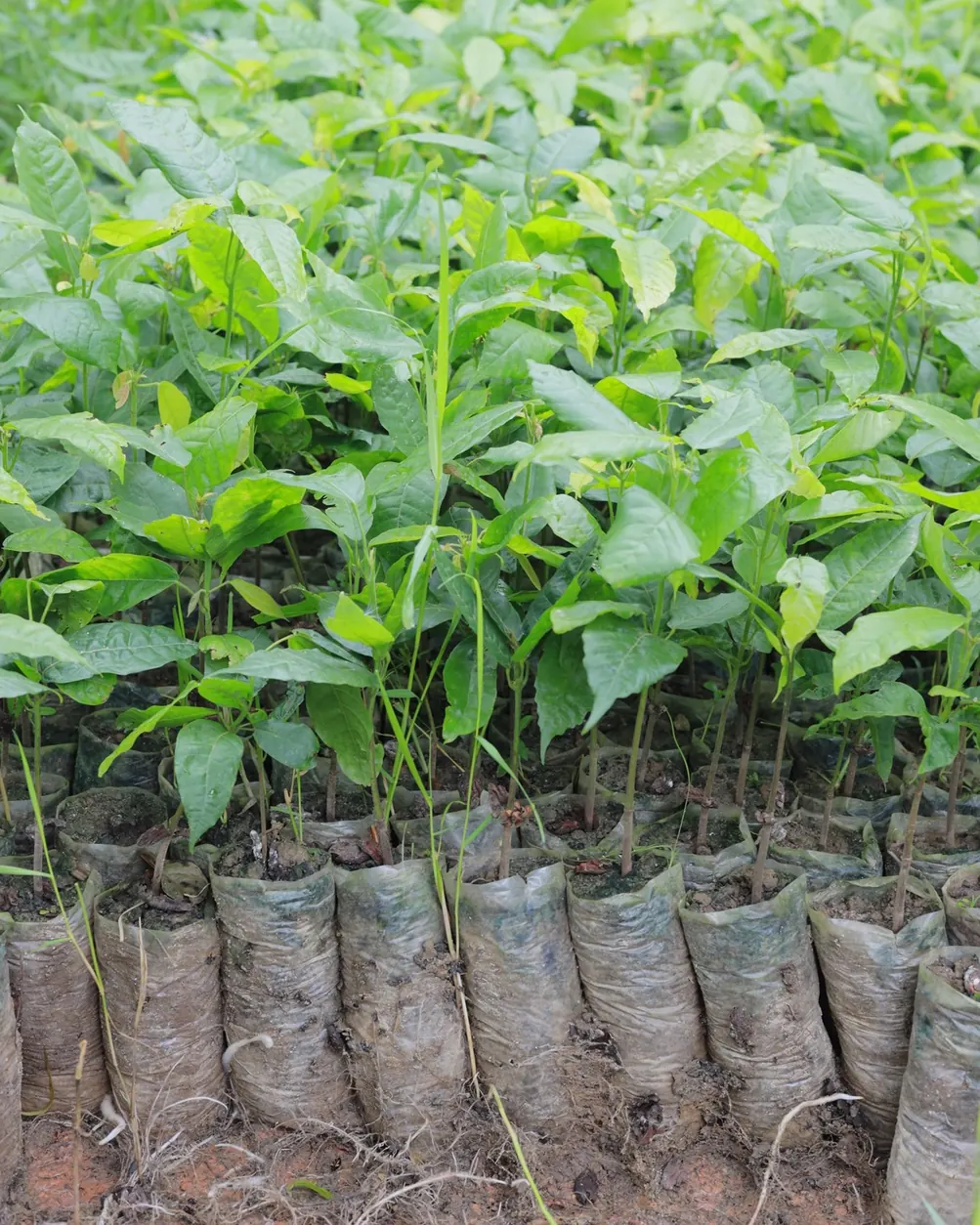
Vietnam’s cocoa story is a long start, a near-disappearance and a small, quality-focused revival. French colonists brought cocoa in the late 19th century, mainly to the Mekong Delta, but support ended in 1907 and cultivation nearly vanished between the 1940s and 1970s. State farms and donor-funded projects revived it from the 1980s and 1990s, and area then rose to a 2012 peak before falling as farmers moved to more profitable crops such as durian and coconut.
| Year | Cocoa area in Vietnam | Source and date checked |
|---|---|---|
| 2012 (peak) | 25,700 ha | CCTD overview; Confectionery News, March 2016; both checked September 22, 2026 |
| 2015 | 11,229 ha | Confectionery News, March 2016, checked September 22, 2026 |
| 2019 | 5,028 ha | CCTD overview, checked September 22, 2026 |
| 2024 | 2,708 ha | Puratos Grand-Place, July 2025, checked September 22, 2026 |
| 2025 | 3,471 ha (2,836 ha harvested); 4,786 t of dry beans | National Agricultural Extension Center, Vietnam Government portal, May 2025, checked September 22, 2026 |
The 2024 and 2025 rows differ by year and by source, and together they describe the same order of magnitude. Officials quoted in May 2025 noted dry-bean prices three to five times higher than a year earlier and warned against rapid expansion, citing earlier price collapses in coffee and pepper.
What varieties and regions does Vietnamese cocoa come from?
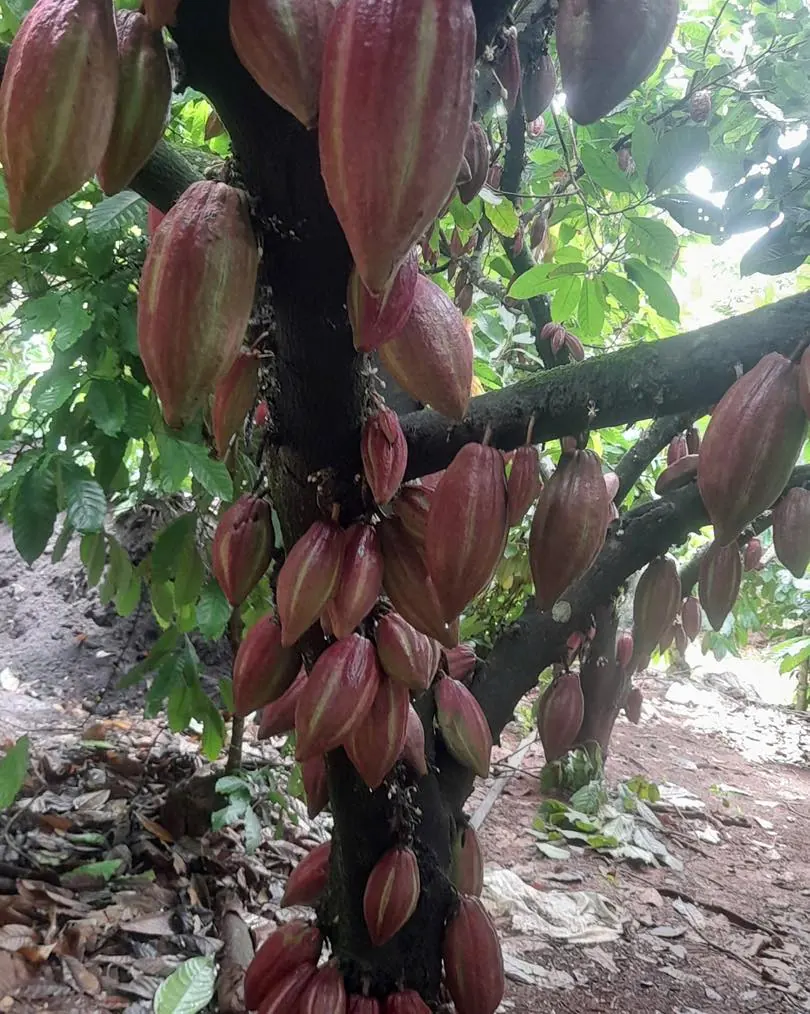
Mostly Trinitario-type trees and Trinitario–Forastero hybrids, grown in three regions: the Central Highlands, the Southeast and the Mekong Delta. Each region’s area, output and flavor are covered in cocoa-growing regions in Vietnam.
Is Vietnamese cocoa “fine flavor” according to the ICCO?
Yes at the country level: the ICCO’s Annex C lists Vietnam at 80% of its cocoa exports as fine or flavor cocoa (October 2023). What that figure means, and how it compares with other origins, is explained in Vietnamese cocoa and its 80% fine-flavor rating.
How do craft chocolate makers see Vietnamese cocoa?
As an origin worth naming by province. Vietnam’s craft scene sells single-origin bars labeled by place: Marou lists six (Ben Tre, Tien Giang, Ba Ria, Dong Nai, Lam Dong and Dak Lak), and the 2018 Academy of Chocolate results list Tbros dark bars named Tien Giang, Dak Lak and Ba Ria. A 2016 trade report described Vietnamese cocoa as Trinitario-type that generally shows notable fresh-fruit notes, sometimes with brown-fruit and floral notes.
Two independent markers are worth knowing, and neither is a country-wide quality stamp:
- Heirloom Cacao Preservation Fund (HCP). The HCP designates individual trees or farms after DNA analysis and a blind flavor panel. Two Vietnamese farms are listed, designated in 2016 and 2024, both with bursaries sponsored by Marou.
- Competitions. At the 2019 International Chocolate Awards World Final, Marou’s Tien Giang Special 75% took Silver in the micro-batch plain dark bar category. Competition medals go to a maker’s finished product, so they describe the chocolate as much as the bean.
Our take: what craft makers value in Vietnam is traceability at farm and province level, which matches the varied ancestry shown in the DNA studies above.
For a taste of how Vietnamese cooks use cocoa, see Vietnamese salted cocoa (cacao muối).
Where does Grevista’s cocoa fit?
Grevista distributes a single-origin Vietnamese Trinitario cocoa powder in the United States. It is made by VNCACAO CO., LTD (Tbros), and it is non-alkalized, unsweetened and one ingredient. Grevista is the distributor, not the manufacturer.
The producer’s medals, two Bronze at the 2018 Academy of Chocolate Awards and one Silver at the 2019 Chocoa Hot Chocolate Awards, belong to the producer and were judged on hot chocolate. The dated lab reports are on Lab Results and Awards, and the medals are explained in Academy of Chocolate Awards explained. See the product in three sizes on Grevista Pure Trinitario Cocoa Powder.
Commercial disclosure: Grevista distributes this cocoa and earns revenue from its sales. See our Affiliate & Commercial Disclosure.
When is the variety the wrong thing to shop by?
Skip variety-based shopping if you buy cocoa powder for baking or drinks and have not yet decided between natural and Dutch-process, because alkalizing changes flavor, color and leavening more than the type of bean. Also skip it when a label names a variety but no farm, region or producer, since a named origin tells you more than the variety name alone; when you are comparing bars or powders on price, because fine-flavor origin often costs more without guaranteeing a taste you prefer; and when you want a specific contaminant level, which is set by the farm and by testing, not by the variety name. For a buying checklist, see how to choose the best cacao powder.
Frequently asked questions
What is the most common type of cacao bean?
Forastero, in the sense of bulk cocoa. The ICCO puts bulk cocoa at 93.5% of world production, while a 2018 review gives about 80% for Forastero. The gap comes from how the groups are defined.
Which cacao type is the rarest?
Criollo, which is low-yielding and disease-prone. Published estimates of its share run from under 5% to about 10% and vary by source, so the share is usually given as a range.
Is Trinitario better than Forastero?
Not automatically. Trinitario tends to be used for fine-flavor cocoa, but the ICCO classes Cameroon’s Trinitario-derived cocoa as bulk, and fermentation and drying can change a lot either way. “Better” depends on the use and the handling.
What variety of cocoa is grown in Vietnam?
Mostly Trinitario-type trees and Trinitario–Forastero hybrids. Studies of Vietnamese cultivars find a mix of Trinitario, Forastero and Amelonado-related ancestry.
Is Vietnamese cocoa fine-flavor cocoa?
The ICCO lists Vietnam at 80% of its cocoa exports as fine or flavor cocoa (Annex C, April 2024). That is a country-level share, so an individual bag still depends on the farm and processing.
How much cocoa does Vietnam produce?
About 4,786 tonnes of dry beans on 3,471 hectares in 2025, according to the National Agricultural Extension Center, roughly 0.1% of world output. Other sources give slightly different recent figures, and the area peaked at 25,700 hectares in 2012.
Keep reading
- Trinitario cacao — the fine-flavor hybrid up close.
- What to know about Vietnamese cocoa — one origin up close.
- Where cocoa grows in Vietnam — the regions.
- Cacao vs cocoa — the names explained.
- How cocoa powder is made — from pod to powder.
Related reading
- The complete cocoa powder guide: every topic, from processing to recipes.
- Academy of Chocolate Awards explained: how a medal is scored and what it does not prove.
- Vietnamese salted cocoa (cacao muối): a Vietnamese way to drink unsweetened cocoa.
- About Grevista: who we are and who makes the cocoa.
Sources
- International Cocoa Organization. Fine Flavor Cocoa (definition, about 12% of exports, Annex C updated April 2024), checked September 22, 2026.
- International Cocoa Organization. Growing Cocoa (three traditional types, ten-group classification, fine flavor just under 5% of production), checked September 22, 2026.
- International Cocoa Organization. FAQ (bulk cocoa 93.5% of world production), checked September 22, 2026.
- International Cocoa Organization. Revision of Annex C, 109th session, April 26, 2024 (Vietnam 80%); earlier revisions: October 2023 and December 2020, checked September 22, 2026.
- International Cocoa Organization. ICCO Panel recognizes 23 countries as fine and flavour cocoa exporters (June 29, 2016; Vietnam 40%), checked September 22, 2026.
- International Cocoa Organization. Quarterly Bulletin of Cocoa Statistics, August 2026 (world production 2024/25: 4.733 million tonnes), checked September 22, 2026.
- Motamayor JC et al. Geographic and genetic population differentiation of the Amazonian chocolate tree (Theobroma cacao L). PLOS ONE. 2008;3(10):e3311. Checked September 22, 2026.
- Motamayor JC et al. Cacao domestication II: progenitor germplasm of the Trinitario cacao cultivar. Heredity. 2003;91:322–330. Checked September 22, 2026.
- Cornejo OE et al. Population genomic analyses of the chocolate tree, Theobroma cacao L., provide insights into its domestication process. Communications Biology. 2018. Checked September 22, 2026.
- Kongor JE et al. Factors influencing quality variation in cocoa (Theobroma cacao) bean flavour profile: a review. Food Research International. 2016;82:44–52. Checked September 22, 2026 (abstract).
- Colonges K et al. Two main biosynthesis pathways involved in the synthesis of the floral aroma of the Nacional cocoa variety. Frontiers in Plant Science. 2021. Checked September 22, 2026.
- Everaert H et al. Molecular characterization of Vietnamese cocoa genotypes (Theobroma cacao L.) using microsatellite markers. Tree Genetics & Genomes. 2017. Checked September 22, 2026 (abstract).
- Everaert H et al. Genetic classification of Vietnamese cacao cultivars assessed by SNP and SSR markers. Tree Genetics & Genomes. 2020;16:43. Checked September 22, 2026 (abstract).
- Journal of Crop Improvement. Revisiting 1727: crop failure leads to the birth of Trinitario cacao. 2012;26(5). Checked September 22, 2026 (title and summary only).
- Confectionery News. Rising dragon: Vietnam to win fine flavor cocoa status. March 21, 2016 (2012 peak, 2015 area, flavor description). Checked September 22, 2026.
- CCTD. Overview of Vietnam’s cocoa industry (in Vietnamese; 2019 area, history, intercropping; undated). Checked September 22, 2026.
- Vietnam Government portal (baochinhphu.vn). Cảnh báo ngành ca cao tăng trưởng nóng (in Vietnamese; May 2025; 3,471 ha, 4,786 t). Checked September 22, 2026.
- Puratos Grand-Place. Is Vietnam paying enough attention to cocoa? July 7, 2025 (2,708 ha in 2024; regions). Checked September 22, 2026.
- Chocolats du Monde. Terroirs du Monde: Vietnam and chocolate (colonial history, 1907, revival). Checked September 22, 2026.
- Academy of Chocolate. Awards 2018 results. Checked September 22, 2026.
- International Chocolate Awards. World Final winners 2019. Checked September 22, 2026.
- Heirloom Cacao Preservation Fund. The Heirloom Mark (designation protocol) and Vietnam designations. Checked September 22, 2026.
- Marou Chocolate. Single-origin collection. Checked September 22, 2026.
Written by the Grevista Editorial Team. Last updated October 24, 2026. How we check facts: Editorial Policy.